

When Should You Refinish a Bathtub?
Most homeowners do not wake up one day and decide to refinish a bathtub. They notice something first: a surface that never quite looks clean anymore, a color that feels dated, a dull patch that used to be glossy, a chip near the drain. The question is whether what you are noticing is the kind of thing refinishing addresses, or a sign of something deeper that needs a different fix.
This guide is about recognizing that moment. It walks through the signs that commonly lead homeowners to look into refinishing, and it is honest about an important point: not every sign means refinishing is the right answer. Refinishing is a surface-restoration process. It works best on a tub that is structurally sound but cosmetically worn. When the underlying tub is the problem, a new finish will not solve it, and no article can tell you which situation you are in without someone looking at the actual tub.
So treat what follows as a way to read your own bathtub, not a diagnosis. If you are trying to decide whether refinishing is a sensible use of your money once you have identified a problem, that is a different question, and our guide on whether bathtub refinishing is worth it is built for it. This page is the step before that one: is it time to have the tub looked at in the first place?
Signs It May Be Time to Consider Refinishing
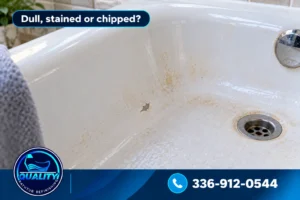
These are the conditions homeowners most often notice. For each, the useful thing to understand is what you are seeing, what it can indicate, and whether it is the kind of problem refinishing tends to address. None of these is a guarantee that refinishing is appropriate; the underlying condition of the tub always matters.
A dull, worn finish. The original gloss has faded, and the surface looks flat or tired even when clean. This is one of the most common cosmetic reasons homeowners look into refinishing, and on a sound tub it is exactly the kind of surface issue refinishing is designed to restore.
Persistent stains and discoloration. Marks that no longer respond to normal cleaning, or a general yellowing or graying of the surface. When staining is in the finish rather than a sign of a failing surface underneath, it may be addressable by refinishing. If a stain reappears quickly or is tied to a rough or pitted area, that is worth having looked at rather than assuming it is purely cosmetic.
Surface scratches. Fine scratches that dull the look of the tub. Light surface scratching is generally a cosmetic issue. Deeper gouges that expose material below the finish are a different matter and may need evaluation.
Minor chips. Small chips, often near the drain, the rim, or where something has been dropped. Localized chips can frequently be addressed as part of the refinishing process, depending on their size, location, and what lies beneath. A chip alone does not usually rule out refinishing, but a chip that has led to spreading damage or exposed substrate should be assessed.
General surface wear. Areas that feel rough, thin, or uneven from years of use and cleaning. Whether this is purely cosmetic depends on how far the wear has gone, which is one of the harder things to judge by eye.
An outdated color. The tub is sound but the color reads as dated, or it clashes with an updated bathroom. This is a legitimate, purely aesthetic reason homeowners consider refinishing. Color options depend on the refinishing system and the specific job, so it is best to ask a professional what is available rather than assuming any color is possible.
A previously refinished surface that is failing. An earlier coating that is peeling, flaking, or wearing through. This one needs care, and it is covered in its own section below, because refinishing over a failing coating is not as simple as adding another layer.
Rust or corrosion-related surface problems. Discoloration or roughness associated with rust. Rust ranges from superficial to substrate-related, and the distinction matters a great deal. It is covered separately below.
An old tub that still works but looks worn. A structurally usable tub, sometimes an older or better-made one, that simply looks its age. Age by itself is not a reason to replace a tub, and a sound older tub that is cosmetically worn can be a candidate for refinishing.
The pattern across all of these: cosmetic and surface-level problems on a sound tub are what refinishing is for. The moment a sign points toward something structural, the right next step is evaluation, not assumption.
Cosmetic Wear Versus Structural Damage
This is the single most important distinction in the whole decision, so it is worth being clear about. Refinishing restores and protects the outer surface of a tub. It does not rebuild or replace the tub underneath. That means the question is almost always: is this a surface problem, or is the tub itself compromised?
Cosmetic and surface issues are problems with the finish or the appearance. A dull surface, staining and discoloration, light scratches, a worn look, an outdated color, and minor surface imperfections generally fall here. On a sound tub, these are the problems refinishing is meant to address.
Structural and substrate issues are problems with the body of the tub or the material beneath the finish. Significant cracks, major holes, severe deterioration of the substrate, and damage that affects the tub’s underlying integrity fall here. These are not surface problems, and a new finish applied over them does not fix the underlying condition.
A caution that goes both ways. Do not assume every crack, chip, rust spot, or hole makes refinishing impossible; some can be repaired as part of the work, and the right answer depends on the material, the location, the severity, whether it is repairable, the condition of the substrate, and the refinishing system involved. Equally, do not assume a bad-looking surface is automatically just cosmetic. The honest reality is that the line between “cosmetic” and “structural” is often the exact thing a homeowner cannot judge reliably from across the bathroom, which is why professional evaluation exists.
What Different Types of Damage Can Mean
It helps to look at the specific problems homeowners ask about most, because each behaves a little differently.
Stains and discoloration are frequently in the finish, and when they are, refinishing can restore the surface. Where they signal a rough, pitted, or failing surface, evaluation is the better first step.
Scratches that are light and shallow are usually cosmetic. Deep scratches that cut through the finish and expose material below may need more than a straightforward surface restoration.
Chips are often localized and can commonly be handled during refinishing, depending on size and location. A small chip is rarely a reason to replace a tub. A chip that has spread, or that sits over a compromised area, is worth a professional look.
Cracks and holes sit in the more serious category. Some can be repaired depending on the material, the location, and the extent; others indicate the tub’s integrity is affected. This is not a call to make by eye, and it is a common reason to get an evaluation before deciding anything.
Rust depends entirely on how deep it goes, which the next section addresses directly.
Across all of these, this guide deliberately does not offer repair instructions. The goal is to help you understand what you are likely looking at, not to turn you into the person fixing it. Where a problem may need repair, that repair should be evaluated by someone who can see and touch the tub.
What About a Previously Refinished Tub That Is Peeling?
If your tub was refinished before and the coating is now peeling, flaking, or wearing through, the instinct is to just have it redone. It is not that simple, and any refinisher worth hiring will say so.
A coating that has failed needs to be evaluated before another coating goes on. Simply applying a new finish over a failing one tends to reproduce the problem. The reasons a previous coating fails vary, and they can include preparation problems, application problems, conditions that were not suitable when the work was done, issues with the substrate, failure of the previous coating itself, or how the surface was used and maintained afterward. No single one of these is universally to blame, and pinning it down usually requires looking at the specific tub.
Depending on what the evaluation finds, a failed coating may need to be removed or otherwise remediated before a new system can be applied properly. That is a reason to treat a peeling refinished tub as an evaluation situation rather than a simple redo. Understanding how the process and preparation work can help here; our overview of the bathtub refinishing process explains why preparation is so central to a durable result, and our guide to refinished bathtub maintenance covers the care that helps a finish last.
A Note on Rust
Rust is one of the most misunderstood signs, because it covers a wide range of situations. The important thing is to separate surface-level rust from rust that reflects a problem with the material itself.
Superficial or surface rust, and rust tied to a small damaged area, is a different situation from corrosion associated with the substrate or extensive deterioration of the tub’s material. Refinishing is a surface process; it does not repair structural deterioration of the underlying metal. Where rust reflects damage below the surface, repair and evaluation of the substrate may be needed before refinishing is even on the table.
So rust is not automatically a reason to replace a tub, and it is not automatically something a coating can cover. It is a clear case for a professional look, because the depth of the problem, which decides everything, is exactly what is hard to judge without inspection.
Is an Old Bathtub a Good Candidate?
Homeowners often assume an old tub should simply be replaced. Age alone does not determine whether a tub is a good candidate for refinishing.
What matters is the tub’s material, its structural condition, the state of its surface, any previous repairs, your goals for the bathroom, the layout, and how you intend to use it going forward. An older tub that is structurally sound but cosmetically worn can be a reasonable candidate for refinishing, and in some cases older tubs are better made or better proportioned than comparable new fixtures, which is a reason some homeowners prefer to keep them. On the other hand, an old tub with genuine structural problems is a different situation, and refinishing will not resolve those.
This is not a universal recommendation in either direction. It is a reminder that “old” and “worn out” are not the same thing, and that a sound old tub with a tired surface is precisely the kind of tub refinishing was made for.
When to Get a Professional Evaluation

Several of the signs above share a common thread: the thing you most need to know is the thing hardest to judge yourself. That is what a professional evaluation is for, and it is why Quality Bathtub Refinishing NC offers free estimates.
It is worth getting a professional look rather than guessing when you see cracks or holes, extensive rust, a previous coating that is peeling, uncertain substrate condition, coating that has failed more than once, or significant water-related damage. In these situations, the difference between a surface problem and a structural one determines whether refinishing is even appropriate, and that is not a determination to make from a photo or a memory.
No honest guide can diagnose your specific bathtub remotely, and this one will not try. What it can do is tell you when assumption is the wrong approach and a trained set of eyes is the right one.
When Refinishing May Not Be the Right Solution
For balance, it is worth naming the situations where recognizing a sign should point you somewhere other than refinishing.
If the tub has serious structural problems, if damage goes beyond what a refinishing and repair system is designed to handle, or if the substrate itself is failing, refinishing is not the fix. If you are already planning a full bathroom remodel, or planned plumbing or layout changes mean the tub is coming out anyway, refinishing it first usually does not make sense. And if what you actually want is a different tub in a different place, refinishing keeps the fixture you have.
These situations are less about the surface signs and more about the bigger picture, and they overlap with the broader “refinish or replace?” decision. That comparison has its own dedicated guide on refinishing versus replacement, which is the right place to work through it in depth.
A Practical “Should I Look into Refinishing?” Checklist
Use these as considerations, not a scoring system. There is no total to add up. The goal is to see your situation clearly enough to decide whether it is time for an evaluation.
- Structural soundness. Does the tub seem solid, or are there signs of cracks, holes, or a failing body?
- Nature of the problem. Is what bothers you mainly the surface appearance, or how the tub functions?
- Stains and discoloration. Are they persistent and unresponsive to normal cleaning?
- Finish condition. Is the surface visibly dull, worn, or thin?
- Scratches and chips. Are there marks that affect appearance, and do any expose material below the finish?
- Color. Is the tub sound but the color dated?
- Previous coating. If it was refinished before, is that coating failing?
- Repairability. Do any problems look like they may need repair rather than simple refinishing?
- Remodel plans. Are you about to remodel the bathroom or change the plumbing or layout?
- Attachment to the tub. Do you still like the tub’s shape and placement?
If most of these point to a sound tub with a surface or appearance problem you would like to fix, it is likely a reasonable time to get an evaluation. If several point toward structural trouble, an imminent remodel, or a tub you would rather replace than keep, refinishing may not be the path, and an evaluation or a look at the replacement comparison is the better next step. You can also see the range of work on the bathtub refinishing services page and request a free estimate to answer the questions you cannot answer on your own.
Frequently Asked Questions
When should I refinish my bathtub?
Homeowners typically consider refinishing when a structurally sound tub has become cosmetically worn: a dull or stained surface, minor chips or scratches, an outdated color, or general wear. The right time is when the problem is with the surface rather than the tub itself. If there are signs of cracks, holes, or substrate failure, an evaluation should come first.
How do I know if my bathtub needs refinishing?
Look at whether the problem is cosmetic or structural. Surface issues like dullness, staining, light scratches, minor chips, and dated color are the kinds of things refinishing addresses on a sound tub. Signs that point deeper, such as significant cracks, holes, or extensive rust, may warrant professional evaluation before any decision.
Is an old bathtub worth refinishing?
It can be, if it is structurally sound. Age alone does not decide it. A sound older tub that is simply worn or dated is often a candidate for refinishing, while an old tub with structural problems is a different situation. Material, condition, and your goals all factor in.
Can a stained bathtub be refinished?
Often, yes, when the staining is in the finish and the tub is otherwise sound. Refinishing restores the surface. If a stain is tied to a rough, pitted, or failing area, that area should be evaluated rather than assumed to be purely cosmetic.
Can a chipped bathtub be refinished?
Localized chips can frequently be addressed as part of the refinishing process, depending on size and location. A chip by itself is rarely a reason to replace a tub. A chip that has spread or exposed the material beneath should be assessed.
Can a rusty bathtub be refinished?
It depends on how deep the rust goes. Surface rust is a different situation from corrosion involving the substrate. Refinishing does not repair structural deterioration of the underlying material, so rust that reflects damage below the surface may require repair and evaluation before refinishing is considered.
Can a peeling refinished bathtub be refinished again?
Sometimes, but not by simply adding another coat. A failed coating needs to be evaluated, and depending on what is found it may need removal or remediation before a new system can be applied. Refinishing over a failing coating tends to repeat the problem.
How do I know if my bathtub needs repair or refinishing?
Refinishing restores a sound surface; repair addresses damage to the tub itself. If the issue is appearance on an intact tub, refinishing is the likely path. If there is cracking, a hole, or substrate damage, repair or evaluation should come first. When it is unclear, a professional estimate is the way to find out.