Why Does My Bathtub Have Stains?
Bathtub stains come from a handful of everyday sources, and the first useful thing to understand is that not all of them are the same kind of problem. Some marks are surface deposits that sit on top of the finish and can often be cleaned away. Others are the finish itself changing, wearing, or being damaged, which is not a stain you can scrub off at all.
A brown ring, a chalky white film, a pink or gray patch, and a dull yellowed area can all get called “a stain,” but they have different causes and different answers.
That is why this guide spends as much time on identifying the stain as on removing it. Cleaning the wrong way, or expecting a cleaner to fix what is actually surface deterioration, wastes effort and can even make things worse.
The goal here is to help you figure out what you are looking at, clean it safely when cleaning is the right approach, and recognize when the appearance problem is beyond cleaning.
One important note up front: if the discoloration is a rust or corrosion issue on a metal tub, that is its own topic, and our guide to bathtub rust and corrosion covers it in depth. Here, rust is treated as just one of several possible causes of a stain.
What Kind of Bathtub Stain Is It?
Identifying the type is the step that determines everything after it. These are the categories homeowners most commonly encounter. This is not a rigid universal taxonomy, and terminology varies between sources, but it covers the marks people actually deal with.
Rust-Colored Stains
Orange or brown marks are often assumed to be rust, but they may be a rust-colored stain from an external source such as hard water, an old fixture, or a metal can left on the surface rather than the tub itself corroding, or they may be genuine corrosion on a metal tub.
Because those are very different situations, this guide does not try to resolve them here. If you are dealing with rust or possible corrosion, the bathtub rust and corrosion guide walks through telling an external rust stain from actual corrosion and what each one calls for.
Hard-Water and Mineral Deposits
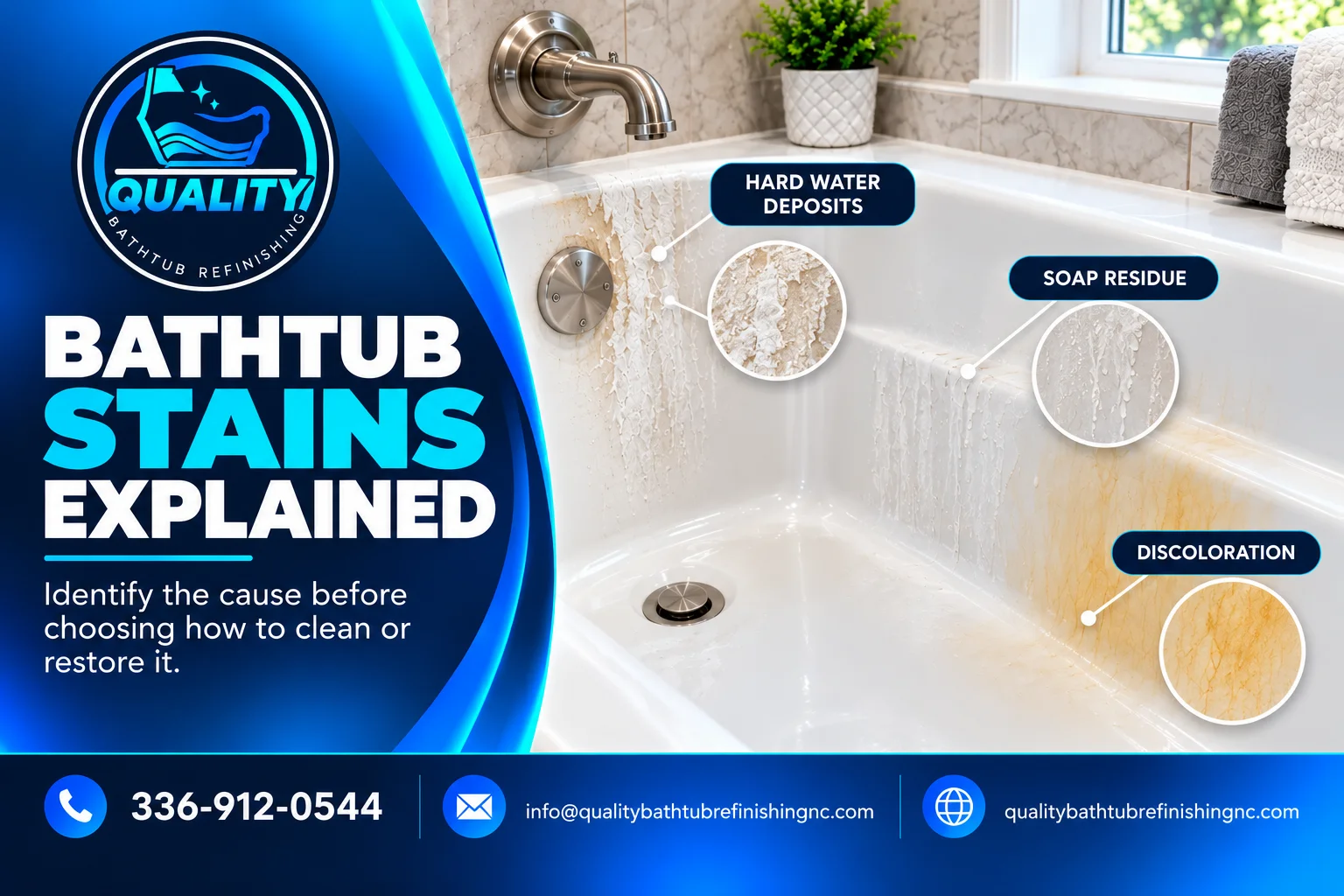
Hard water leaves behind minerals as it evaporates, and over time those can build up as a chalky, cloudy, or crusty deposit, often near the faucet, the drain, or wherever water sits or drips.
Mineral deposits sit on the surface, so they are frequently among the more cleanable marks with an appropriate method, though heavy buildup can be stubborn.
Soap Scum and Product Residue
Soap, shampoo, bath products, and cleaning-product residue can accumulate into a dull film or patchy marks.
This is residue on top of the finish rather than damage to it, so it generally responds to appropriate regular cleaning, and it tends to come back if products keep accumulating without regular cleaning.
Organic Stains and Mildew
Damp conditions can allow mildew or other organic growth, often showing as pink, gray, or dark marks, particularly in areas that stay wet or around caulk and grout lines.
These are a cleaning-and-moisture matter. Addressing the dampness is part of keeping them from returning.
Yellowing and General Discoloration
A general yellowing or dulling across the tub is a common one to misread.
Sometimes it is a removable film from products or hard water. Other times it is the finish itself aging, wearing, or discoloring, which is not a surface deposit and will not clean off.
Which one it is determines whether cleaning has any chance of helping.
Stains That May Actually Be Surface Damage
This is the category worth the most caution. A mark that will not clean off, that sits in a rough, dull, or pitted spot, or that reappears immediately after cleaning may not be a stain at all.
It may be the finish worn, damaged, porous, or deteriorating, which absorbs and holds discoloration in a way a sound surface does not.
No cleaner removes damage. Recognizing that a “stain” is really surface deterioration is what tells you cleaning is not the path.

Does the Bathtub Material Matter?
Yes, and it matters most for one reason: the cleaning method that is safe on one surface can damage another.
The right approach depends on the bathtub surface, so identifying the material comes before choosing a product or a tool.
The materials you are most likely to have are porcelain or enamel, cast iron with an enamel surface, fiberglass, acrylic, cultured marble or other manufactured surfaces, and steel with an enamel surface.
Enameled surfaces such as porcelain, cast iron, and steel are harder and glassy. Fiberglass and acrylic surfaces are softer and more easily scratched or dulled by abrasive products and pads.
The safest guidance is not a single cleaner recommended for every tub because there is no such universal product. Instead, follow the manufacturer’s instructions for your tub, the product’s own label, and any care instructions your refinisher gave you, plus surface-specific guidance for your material.
What is gentle and appropriate on a hard enamel surface may scratch or haze a softer acrylic one, so a cleaner being safe on someone else’s tub does not make it safe on yours.
The material is the first thing to confirm, and the fuller material picture is in our guide on what different bathtub materials mean for surface work.
A Note on Refinished Bathtubs
This deserves its own attention because a refinished tub is a special case.
A bathtub that has been professionally refinished has a coating on it, and that coating may have different care requirements than the original factory finish did.
Not every refinished tub uses the same coating system, so there is no single rule that applies to all of them.
The important practical point: if your tub has been refinished, follow the specific care instructions provided for your finish rather than assuming a cleaner or method that suited the original surface is still appropriate.
Using the wrong product or an abrasive pad on a refinished surface can dull or damage it.
If you had the tub refinished and were given aftercare guidance, that guidance is the authority for how to clean it.
For general care of a refinished surface, our maintenance guide covers the principles, but your specific finish’s instructions come first.
How to Remove Bathtub Stains Safely
Rather than a list of recipes, the reliable approach is a set of principles that apply across surfaces and stain types.
This guide deliberately does not give chemical formulas because the safe method depends on your surface and product, and getting it wrong can damage the finish or create a hazard.
- Start with the least aggressive method that is appropriate. Begin gentle and only escalate if needed rather than reaching for the strongest option first.
- Follow the surface manufacturer’s instructions and any care guidance for your specific finish.
- Read and follow the product label, including its directions and any safety and ventilation guidance.
- Test an unfamiliar product in an inconspicuous area first when appropriate, so you learn how your surface reacts before treating a visible spot.
- Avoid abrasive tools and scouring pads on surfaces they can scratch, particularly fiberglass, acrylic, and refinished finishes.
- Never mix cleaning products. Combining certain cleaners can produce dangerous fumes.
- Ventilate when the product instructions call for it.
- Stop if the surface starts to dull, haze, or show damage because that means the method is too harsh for that finish.
The logic behind starting gentle is simple: you can always escalate a cleaning approach, but you cannot undo a scratched or hazed finish.
Matching the method to the stain type also matters. A mineral deposit, a soap film, and an organic mark do not all respond to the same approach, which is another reason identifying the stain first pays off.
What Not to Use on a Bathtub Surface
A few things are worth avoiding regardless of the stain.
Do not mix bleach with acids, ammonia, or other cleaners because those combinations can create toxic gases.
Do not assume a stronger or industrial chemical is simply a better version of a household one. Harsher is not safer, and some products can damage a finish or carry serious health hazards.
Do not use industrial refinishing chemicals or strippers to try to remove a stain, and in particular do not use methylene chloride or similar hazardous refinishing chemicals.
Avoid abrasive powders, harsh scouring pads, and scrapers on softer or refinished surfaces, where they can leave permanent scratches or dulling that are worse than the stain you started with.
Why Bathtub Stains Keep Coming Back
A stain that returns after cleaning usually means the source is still there, not that the cleaning failed.
Possible reasons a stain recurs include:
- The original source is still present.
- Mineral-rich hard water continues to deposit material.
- Ongoing moisture conditions encourage organic growth.
- Untreated rust or corrosion remains on a metal tub.
- A surface remains damaged or porous and keeps absorbing discoloration.
- An unsuitable cleaning method is not actually addressing that stain type.
- Residue simply keeps accumulating.
No single one of these is always the cause.
The practical takeaway is that if a stain keeps coming back, it is worth looking at the source, whether that is the water, a moisture issue, an accumulation habit, or the condition of the surface itself, rather than just cleaning more often or more aggressively.
When Cleaning Is Not Enough
Cleaning is the right tool for surface deposits and residue, but there are clear signs it is not going to solve the problem.
Professional assessment tends to make sense when:
- The stain does not respond to appropriate cleaning.
- Discoloration keeps returning despite cleaning.
- The surface itself looks worn.
- The finish is visibly damaged.
- The discoloration is tied to rust or corrosion.
- The surface is chipped, cracked, peeling, or otherwise compromised.
- The appearance problem covers a large area.
- You suspect the “stain” is actually the surface deteriorating rather than a deposit on top of it.
The unifying point is that these are situations where the appearance problem is in or under the finish, not on it, and no amount of cleaning reaches that.
Importantly, a persistent stain does not automatically mean the tub needs refinishing. The right first step is to identify the underlying cause because the cause determines the fix.
Can Refinishing Fix a Permanently Stained Bathtub?
Sometimes, but refinishing is not the automatic answer to every stain, and it is worth being precise about when it fits.
Refinishing changes the appearance of a bathtub surface by preparing it and applying a new finish, so where the surface itself is worn, permanently discolored, or otherwise past what cleaning can restore, refinishing may be one option for restoring its appearance.
Where it does not fit is when the discoloration comes from something a new finish would not address.
If the stain is removable residue, mineral buildup, rust or corrosion, or contamination, the appropriate treatment is to deal with that cause, not to coat over it. Coating over an unaddressed problem such as active rust or a moisture source tends to disappoint.
Two things this guide will not claim: that refinishing can remove every stain, and that refinishing fixes underlying plumbing or moisture problems. It does neither.
Refinishing restores a surface. It does not stop hard water from depositing minerals or fix a leak that is feeding organic growth.
The honest position is that refinishing can be a genuine restoration option for a surface that is worn or permanently discolored once any underlying cause has been dealt with, but it is not a universal stain remover.
Our guide on repair versus refinishing covers where each fits.
What a Professional Should Check
When cleaning has not solved a discoloration and you bring in a professional, a useful assessment generally considers:
- The tub material.
- The stain’s color.
- Its location.
- Its pattern.
- Whether it is raised or embedded in the surface.
- Whether it changes at all with cleaning.
- The condition of the surrounding surface.
- Any previous coatings.
- Any previous refinishing.
- Whether rust or corrosion is involved.
- Moisture exposure.
- The age and condition of the finish.
There is no single official industry checklist for this, but these are the practical things that help determine which of three situations you have: a surface deposit, a deeper discoloration, or actual surface damage.
That distinction decides what, if anything, can be done beyond cleaning.
Can You Remove Bathtub Stains Yourself?
For simple surface residue, often yes.
Soap film, light mineral deposits, and everyday grime frequently respond to appropriate household cleaning, and there is no need to call anyone for those.
The keys are to do it in a way that suits your surface and does not cause damage:
- Identify the surface first, so you use a method appropriate to it.
- Follow product instructions and any care guidance for your finish.
- Avoid abrasive tools on delicate, softer, or refinished surfaces.
- Do not mix chemicals.
- Do not assume stronger chemicals are better. They carry more risk to both you and the finish.
- Stop if the surface becomes damaged, dull, or hazed.
- Seek professional advice for persistent or unusual discoloration, especially anything that will not clean off or that looks like it may be in the surface rather than on it.
The honest boundary is between cleaning and repair.
Removing a deposit from a sound surface is a reasonable homeowner task. Trying to “clean away” what is actually worn or damaged finish is not, and reaching for harsher and harsher chemicals in that situation risks damaging the tub without solving the appearance.
How Much Does Professional Bathtub Stain Removal Cost?
For a stain that is really just surface residue, you may not need professional service at all, so there may be no cost beyond an appropriate household cleaner.
When a discoloration turns out to require professional restoration, there is no single reliable price, and this guide will not invent one.
The cost depends on what is actually causing the discoloration, the condition of the surface, the tub material, the extent of any damage, the preparation required, whether repair is needed, whether refinishing is involved, and local labor and company pricing.
A light residue is a different situation and cost from a worn surface that needs refinishing.
Reliable current North Carolina pricing specific to this is not something this guide can state without a source, so it does not. A free estimate is the way to price a specific situation.
For refinishing pricing as a separate consideration, our cost guide covers it.
Questions to Ask Before Hiring a Bathtub Restoration Company
If cleaning has not solved the discoloration and you are considering professional help, a few questions clarify the situation:
- Can you identify my tub’s material and tell me whether this is a surface stain, a deeper discoloration, or surface damage?
- Is this something cleaning or treatment can address, or is the finish itself the problem?
- If it is rust or corrosion, how would you approach it, and is the source being addressed?
- Would refinishing actually solve this, or would the underlying cause need to be dealt with first?
- Is there a moisture or water source contributing to this that I should address?
- What does your written warranty cover, and for how long?
- Do you offer a free estimate so I can understand the scope before committing?
Quality Bathtub Refinishing NC offers free estimates and a written warranty, so those last two are reasonable to expect.
The others help you tell a provider who diagnoses the cause from one who would simply coat over it.
If the answer turns out to be surface restoration, the bathtub refinishing services page shows the scope of that work.
Frequently Asked Questions
How do I remove stains from a bathtub?
Start by identifying the stain and your tub’s surface, then use the least aggressive appropriate method, following the manufacturer’s and any finish-specific care instructions and the product label. Surface deposits like soap film and light mineral buildup often clean off. A mark that will not respond may be in or under the finish rather than on it, which cleaning cannot fix.
What causes brown stains in a bathtub?
Brown or orange marks may be a rust-colored stain from hard water or an external metal object, or they may be genuine corrosion on a metal tub, which are different situations. Because rust and corrosion have their own considerations, our bathtub rust and corrosion guide covers how to tell them apart and what each requires.
How do I remove hard-water stains from a bathtub?
Hard-water and mineral deposits sit on the surface, so they often respond to an appropriate cleaning method suited to your tub material, starting gentle and following product instructions. Heavy buildup can be stubborn, and since hard water keeps depositing minerals, the deposit tends to return unless the water condition or cleaning routine changes.
Why does my bathtub keep getting stained?
A recurring stain usually means the source is still present: mineral-rich water, ongoing moisture, untreated rust, a damaged or porous surface, an unsuitable cleaning method, or accumulating residue. Rather than cleaning harder, it is worth identifying and addressing the source.
Can rust stains be removed from a bathtub?
It depends on whether it is an external rust stain or actual corrosion of a metal tub. A surface rust stain from an outside source may clean off, while corrosion of the tub’s own metal is a repair matter, not a cleaning one. Our bathtub rust and corrosion guide explains the difference and the appropriate approach.
Can I use abrasive cleaners on a bathtub?
It depends on the surface. Abrasive powders and scouring pads can scratch or dull softer surfaces like fiberglass and acrylic and can damage refinished finishes, so they should be avoided on those. Even on harder enamel surfaces, gentler methods are safer to start with. Always follow the guidance for your specific material and finish.
Can bathtub refinishing remove permanent stains?
Refinishing restores a surface by applying a new finish, so it can address a surface that is worn or permanently discolored once any underlying cause is dealt with. It is not a universal stain remover, though. It does not remove a stain caused by an untreated source like rust or a moisture problem without that source being addressed, and it does not fix plumbing or moisture issues.
How do I clean a refinished bathtub?
Follow the specific care instructions provided for your finish because a refinished tub has a coating that may need different care than the original surface, and not all coatings are the same. In general, avoid abrasive tools and harsh products, but your finish’s own aftercare guidance is the authority.
Can I remove bathtub stains myself?
Often, for simple surface residue, using an appropriate method for your surface. Identify the material first, follow product instructions, avoid abrasives on delicate or refinished surfaces, do not mix chemicals, and stop if the surface is being damaged. For persistent or unusual discoloration, or anything that may be surface damage rather than a deposit, professional advice is the better route.
When should I refinish a stained bathtub?
Refinishing becomes worth considering when the discoloration is in or under the finish rather than on it, meaning the surface is worn, permanently discolored, or otherwise past what cleaning can restore, and once any underlying cause has been addressed. A stain that cleans off does not call for refinishing. A permanently discolored or worn surface might.