
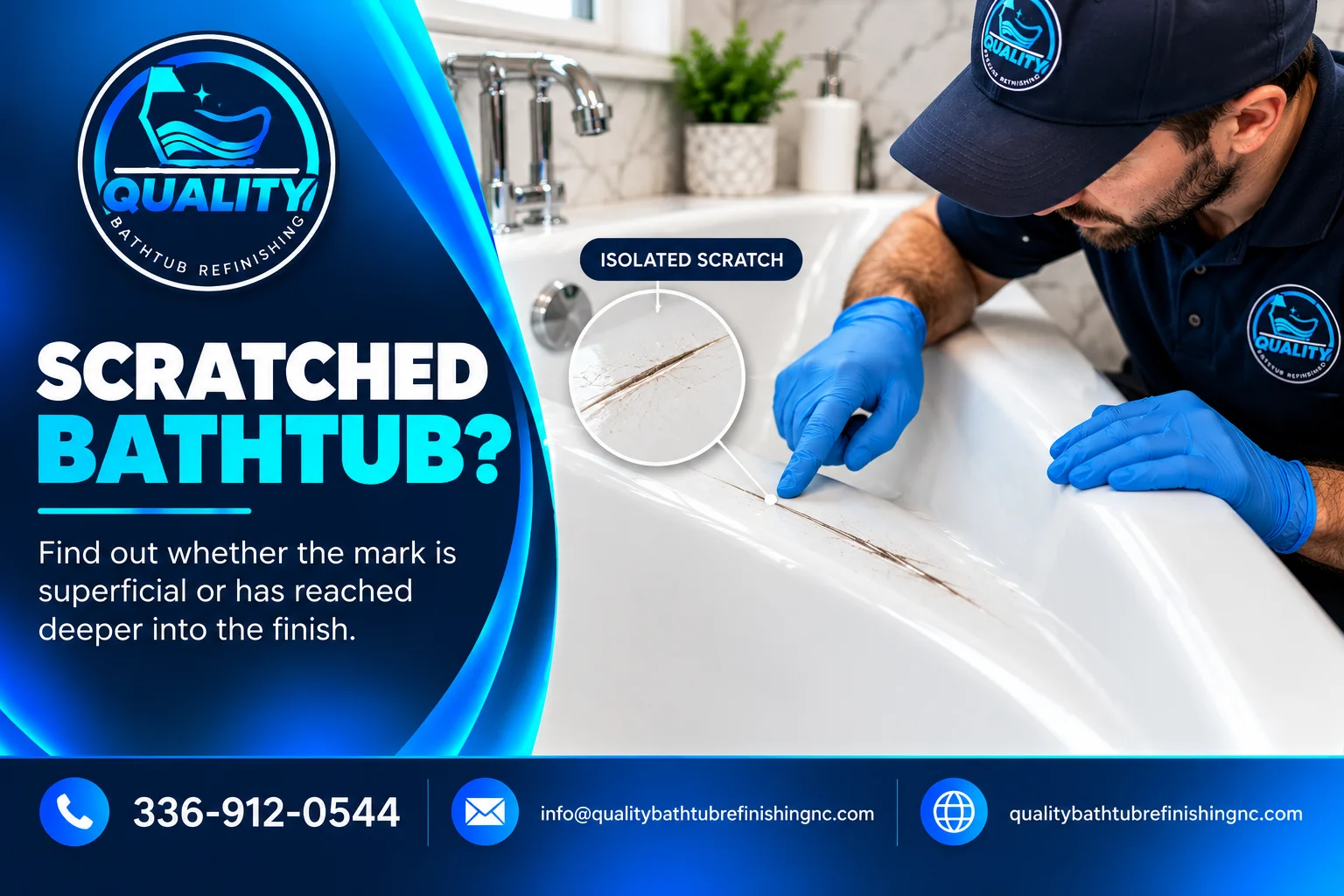
What Does a Scratch on a Bathtub Mean?
A scratch is a linear mark or abrasion on the surface, and it is worth knowing up front that “scratch” covers a range. What looks like a single line could be a superficial mark that barely touches the finish, a broader area of abrasion, damage to the finish itself, a deeper scratch that has reached a layer beneath, or a scratch showing up on a surface that is already worn. Those are not all the same problem, and they do not all call for the same response.
One honest limitation to state early: you cannot always tell how deep a scratch goes just by looking at it. How a scratch appears depends on the material, the coating, the lighting, the tub’s color, and the overall condition of the surface, so a mark that looks alarming may be shallow and one that looks faint may be deeper than it seems.
This guide helps you think through what you are looking at, when a scratch is likely cosmetic, when it may be more than that, and what your options are. Scratches are generally the mildest of the common surface issues, but “generally” is not “always,” which is why the depth question matters.
For the full range of tub surface problems, our guide to bathtub surface damage covers the broader picture.
What Causes Bathtub Scratches?
Most scratches come from abrasion or contact, and no single cause explains all of them.
Common contributors include abrasive cleaning tools such as scouring pads or stiff brushes, abrasive powder cleaners, objects that are dropped or dragged across the surface, metal items like razors or cans, bathroom hardware and fixtures, pet claws in some households, repeated friction in one area, and previous cleaning or repair attempts that were too aggressive.
Normal wear also plays a role, and how easily a surface scratches depends on the material and finish.
The reason cause matters is that many scratches are self-inflicted through cleaning, which means changing the cleaning approach, covered later, is often the most effective way to stop new ones from appearing.
None of these is the universal cause, and a scratch’s appearance does not reliably tell you which one produced it.
Scratch vs. Chip vs. Crack
These three get used loosely, so a quick distinction helps you know which guide you actually need.
A scratch is usually a linear abrasion or mark on the surface.
A chip is a localized spot where finish or material has broken away, leaving a small crater. Our guide on repairing a chipped tub covers that.
A crack is a fracture or split through the surface or material, which can carry deeper implications. Our guide on repairing a cracked tub covers that.
These definitions are useful for understanding, not an official universal classification, and the everyday versions overlap at the edges. A deep scratch and a fine crack can be hard to tell apart.
This guide stays on scratches. If what you have is really a chip or a crack, the linked guides are the better fit.
Does the Bathtub Material Matter?
Yes, because both how easily a tub scratches and what can be done about it depend on the surface.
Identifying the material comes first. The fuller material picture is in our guide on what different bathtub materials mean for surface work. Here is how material bears on scratches specifically.
Acrylic and fiberglass surfaces are softer than enameled metal, so they can scratch more easily, including from abrasive cleaning, and they are also more easily dulled or hazed by aggressive scrubbing.
Porcelain and enameled surfaces, including cast iron and steel tubs with an enamel finish, are harder and more scratch-resistant, though not scratch-proof, and abrasive methods can still mar them.
Cultured marble and other manufactured surfaces have their own characteristics again.
Across all of them, a scratch that stays within a surface coating is a different situation from one that has reached an underlying layer or the material beneath, and that difference matters more than the material name alone.
The practical implication is the same in every case: match the cleaning and any repair to the specific surface, because what is safe on a hard enamel finish can damage a softer acrylic one.
How Deep Is the Scratch?
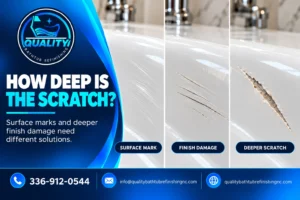
Depth is the single most useful thing to gauge, because it separates a cosmetic mark from something more.
A homeowner can consider a few informal observations:
- The visible depth of the scratch.
- Whether another color or a different layer is showing through it.
- Whether it catches a fingernail or can be felt by touch.
- Whether the surrounding finish is worn.
- Whether the scratch is isolated or part of broader damage.
- Whether it appears to expose metal or another substrate underneath.
Two cautions matter here.
First, these are informal observations, not a diagnosis. In particular, whether a scratch catches a fingernail is sometimes offered as a test, but it does not prove whether a scratch is repairable or how it should be treated. Treat it as one rough clue among several, not a verdict.
Second, exposed underlying material, a different color showing through, or a scratch that seems to reach metal moves the situation out of “simple cosmetic mark” territory and toward something worth having looked at.
The honest summary: shallow surface scratches are usually cosmetic, deeper ones that reach past the finish are not, and you cannot always be sure which you have from a glance, which is exactly why a professional look is useful when there is any doubt.
Can a Bathtub Scratch Be Repaired?
In most cases yes, in some form, and the right answer depends on the material and the severity.
Depending on those, a scratch may be:
- Cosmetic and require no repair at all, if it is faint and does not bother you.
- Addressable through an appropriate surface treatment, for a light surface mark on a suitable finish.
- Repairable through localized restoration, for a more noticeable but still contained scratch.
- Part of a broader finish problem where refinishing is the better fit, when the scratch is one of many or the surface is generally worn.
What this guide will not claim is that every scratch can be repaired invisibly, or that color and texture will always match perfectly.
How well a repair blends depends on the surface, the finish, the color, and the severity, and a repair that is technically sound can still be faintly visible under certain lighting.
Being realistic about that is part of an honest answer.
For a light, isolated mark on a sound surface, expectations are reasonably high. For a deep scratch or one on a difficult surface, blending is harder, and that is worth knowing before you decide.
Bathtub Scratch Repair vs. Refinishing
These are different scopes, and for scratches the choice usually comes down to how many there are and the state of the surrounding finish.
Localized scratch repair addresses a specific damaged area.
Refinishing restores the broader visible surface by preparing it and applying a new finish.
So:
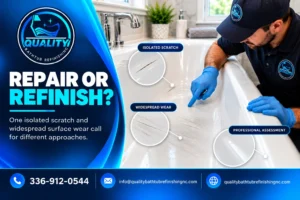
- If the scratch is isolated and the surrounding surface is in good condition, a localized solution may be all that is needed.
- If the tub has many scratches, widespread wear, discoloration, or an aging finish, broader refinishing may be the more sensible route, because spot-repairing many marks on a tired surface tends to leave an inconsistent result.
Neither is automatically correct.
Refinishing is not automatically necessary for a scratch, and it is not automatically more durable than a good localized repair. Each fits a different situation.
The deciding factors are the number and severity of the scratches and the condition of the finish around them.
Our guide on repair versus refinishing covers that broader decision, but for scratches specifically the rule of thumb is: one mark on a good surface leans toward localized repair, many marks on a worn surface lean toward refinishing.
What Can Make a Bathtub Scratch Worse?
Several common reactions to a scratch can enlarge it or damage the surrounding finish, and avoiding them matters as much as the repair itself.
Things that tend to make scratches worse include:
- Abrasive pads and scouring pads.
- Aggressive scrubbing.
- Unsuitable or harsh cleaners.
- Dragging objects across the surface.
- Attempting an incompatible DIY repair.
- Escalating to increasingly aggressive chemicals when a mark does not come out.
A specific caution: this guide does not tell homeowners to sand a bathtub surface, because sanding is a surface-specific technique that can permanently damage a finish if done wrong or on the wrong material, and it is not a general homeowner fix.
Likewise, this guide does not provide industrial refinishing instructions or recommend hazardous refinishing chemicals such as methylene chloride. Authoritative bodies including the EPA, OSHA, and NIOSH have published safety information on hazardous chemicals used in bathtub refinishing.
The safest instinct with a scratch is to stop escalating. If gentle, appropriate cleaning does not address it, that is the point to get advice rather than reach for something harsher.
A Note on Refinished Bathtubs
If your tub has already been refinished, scratches on it are a special case.
A refinished bathtub has a coating with its own care requirements, and not every refinished tub uses the same coating system, so there is no single rule that applies to all of them.
Do not assume a cleaner, tool, or repair product that would suit an original factory surface is appropriate for a refinished one, and avoid abrasive pads and harsh products on a refinished finish, which can dull or scratch it further.
If you were given aftercare guidance for your finish, that guidance is the authority for how to clean it and what to avoid.
For a scratch on a refinished tub, the refinisher who did the work is usually the right first call, since they know the coating.
Our maintenance guide covers general care principles, but your specific finish’s instructions come first.
What a Professional Should Inspect
When a scratch is more than a faint cosmetic mark and you bring in a professional, a useful assessment generally considers:
- The tub material.
- The scratch’s location.
- Its extent.
- Its visible depth.
- The condition of the surrounding finish.
- Whether an underlying layer is exposed.
- Any previous refinishing.
- Any previous repairs.
- The overall condition of the surface.
- Whether there are multiple scratches or other forms of damage alongside it.
There is no single official industry checklist for this, but these are the practical things that determine whether a localized repair will look right or whether broader restoration makes more sense, which is the real question a scratch raises once it is past the “leave it alone” stage.
What Happens During Professional Scratch Repair?
At a homeowner level, addressing a scratch professionally generally follows a sequence something like the one below.
These are general industry stages, not a description of any one company’s exact documented procedure, and the specific products, materials, and timings vary by the system used and are not detailed here.
- Identify the surface and material.
- Assess the scratch and the surrounding finish.
- Determine whether localized repair or broader restoration is appropriate.
- Prepare the affected area using a material-compatible process.
- Restore the damaged area where appropriate.
- Blend or restore the surrounding finish if needed.
- Allow the system to cure according to the product requirements.
- Inspect the finished surface.
The step homeowners tend to underestimate is the third: deciding whether a single scratch should be spot-repaired or whether the surface as a whole is better served by refinishing.
That judgment is what keeps a repair from standing out against a worn surface, and it is why a professional looks at the whole tub, not just the one mark.
Can You Repair Bathtub Scratches Yourself?
For a minor, superficial surface mark, you may not need professional help at all, and living with a faint scratch that does not bother you is a perfectly reasonable option.
DIY repair becomes more complicated, and more likely to disappoint, when the scratch is deep, when another material layer is exposed, when the tub has an existing refinished coating, when color matching matters, when there are multiple damaged areas, when you are unsure of the material, or when previous DIY repairs are already present.
In those situations a home repair is harder to get right and can make later professional work more difficult.
A safety and technique note: this guide does not provide hazardous chemical instructions or detailed industrial refinishing procedures, and it specifically does not advise sanding a tub as a general fix.
Do not mix cleaning chemicals, and do not assume a harsher product is a better one.
The reasonable boundary is that light surface marks on a known, sound surface can be a homeowner task with an appropriate gentle method, while anything deep, on an uncertain or refinished surface, or accompanied by other damage is better assessed by a professional.
How Much Does Bathtub Scratch Repair Cost?
For a faint surface mark you decide to live with or address with gentle cleaning, there may be no cost at all.
When a scratch does warrant professional attention, there is no single reliable price, and this guide will not invent one, because the cost depends on:
- The tub material.
- The severity of the scratch.
- The number of scratches.
- The condition of the surface.
- The preparation required.
- Whether it is a localized repair or broader refinishing.
- Accessibility.
- Local labor and company pricing.
A single light scratch is a very different scope, and cost, from a worn tub with many scratches that is better refinished.
Reliable current North Carolina pricing specific to scratch repair is not something this guide can state without a source, so it does not.
A free estimate is the way to price a specific situation.
For refinishing pricing as a separate consideration, our cost guide covers it.
When Should You Consider Refinishing?
Refinishing becomes the more relevant option when the issue is no longer one isolated scratch but the surface as a whole.
It is worth considering when:
- Scratches are widespread.
- The finish is generally worn.
- Multiple surface defects are present.
- Discoloration accompanies the scratches.
- The tub’s overall appearance is poor.
- Localized repairs would leave a visibly inconsistent finish against the surrounding surface.
What this guide will not suggest is that every scratched bathtub needs refinishing, because a single minor scratch clearly does not, or that refinishing will eliminate every visible defect, because outcomes depend on the surface and its condition.
Refinishing restores the whole surface, which is exactly what makes it fit a broadly worn or multiply-scratched tub and overkill for one faint mark.
How to Prevent Future Bathtub Scratches
Since many scratches come from cleaning and contact, prevention is largely about how the tub is cleaned and used.
Practical habits that help:
- Avoid abrasive pads, scouring powders, and stiff brushes, especially on softer or refinished surfaces.
- Use gentle cleaning methods appropriate to your surface and follow the manufacturer’s or refinisher’s care instructions.
- Avoid dragging metal or hard objects across the tub.
- Be careful with items stored on the rim that can fall or scrape.
- Address the cleaning approach if you notice new scratches appearing, since the cleaning method is a common source.
None of this makes a tub scratch-proof, but because so many scratches are self-inflicted through cleaning, adjusting that is often the most effective prevention available.
Questions to Ask Before Hiring a Bathtub Refinishing Professional
A few questions clarify the situation and help you compare providers:
- Can you identify my tub’s material, and does this look like a surface scratch or something deeper?
- Is this better addressed as a localized repair or by refinishing the surface, and why?
- How closely will a repair blend, given my tub’s color and finish, and is any visibility likely?
- If my tub was refinished before, does that change how you would approach the scratch?
- Would you recommend leaving a minor scratch alone rather than risking a visible repair?
- What does your written warranty cover, and for how long?
- Do you offer a free estimate so I can understand the scope before committing?
Quality Bathtub Refinishing NC offers free estimates and a written warranty, so those last two are reasonable to expect.
The others help you tell a provider who will honestly say when a scratch is best left alone or best handled with refinishing from one who treats every mark the same way.
If broader surface restoration is the answer, the bathtub refinishing services page shows the scope of that work.
Frequently Asked Questions
Can Scratches in a Bathtub Be Repaired?
In most cases, in some form, depending on the material and severity. A faint scratch may need nothing, a light one may respond to an appropriate surface treatment, a more noticeable one may be addressed by localized restoration, and a tub with many scratches may be better refinished.
Not every scratch can be repaired invisibly, though, and how well a repair blends depends on the surface and the scratch.
How Do I Remove Scratches From a Bathtub?
Start by identifying your surface and using a gentle, appropriate method, following the manufacturer’s or your refinisher’s care instructions.
Light surface marks may improve with appropriate cleaning. Deeper scratches that reach past the finish are not something cleaning removes and may need professional assessment.
Avoid abrasive pads and harsh chemicals, which can make a scratch worse.
Can You Repair Scratches in an Acrylic Tub?
Acrylic is a softer surface that can scratch more easily and can be dulled by abrasives, so repairability and the right method depend on the depth and the specific surface.
Light marks may be addressable, but acrylic should be treated gently, and a professional can advise on a deeper scratch.
Avoid abrasive cleaning that can add more scratches.
Can Fiberglass Bathtub Scratches Be Repaired?
Often, depending on depth.
Fiberglass has a gel-coat surface that can be scratched, and light surface scratches may be addressable, while a scratch that has reached the fiberglass beneath is a different situation.
The appropriate approach depends on the specific damage, which a professional can assess.
Can Scratches in a Porcelain Tub Be Repaired?
Porcelain and enameled surfaces are harder and more scratch-resistant, but not scratch-proof, and abrasive methods can still mar them.
Whether a scratch can be improved depends on its depth and whether it has reached past the enamel.
A light surface mark and a scratch that exposes the material beneath are different situations.
Are Bathtub Scratches a Sign That the Tub Needs Refinishing?
Not necessarily.
A single minor scratch usually does not call for refinishing.
Refinishing becomes worth considering when scratches are widespread, the finish is generally worn, or multiple surface issues are present, so the surface as a whole would benefit from restoration rather than a spot repair.
Can I Repair Bathtub Scratches Myself?
A minor, superficial mark on a known, sound surface can be a reasonable homeowner task with a gentle, appropriate method.
DIY becomes riskier when the scratch is deep, exposes another layer, is on a refinished coating, requires color matching, or comes with other damage.
Do not sand the tub or use harsh or industrial chemicals, and stop if the surface is being damaged.
Will Bathtub Refinishing Remove Scratches?
Refinishing restores the whole surface by applying a new finish, so it can address scratches as part of restoring the surface, which is why it fits a broadly scratched or worn tub.
It is not the right tool for a single faint scratch, and it will not necessarily eliminate every visible defect. Outcomes depend on the surface and its condition.
How Much Does Bathtub Scratch Repair Cost?
There is no single reliable figure.
Cost depends on the material, the severity and number of scratches, the surface condition, the preparation required, whether it is a localized repair or refinishing, accessibility, and local pricing.
A faint mark you clean yourself may cost nothing. A professional job is best priced with a free estimate.
How Can I Prevent Scratches on My Bathtub?
Since many scratches come from cleaning and contact, avoid abrasive pads, scouring powders, and stiff brushes, especially on softer or refinished surfaces.
Clean gently using methods suited to your surface, avoid dragging hard objects across the tub, and reconsider your cleaning approach if new scratches appear.
No tub is scratch-proof, but gentler care prevents many scratches.