What does a bathtub look like before and after refinishing?
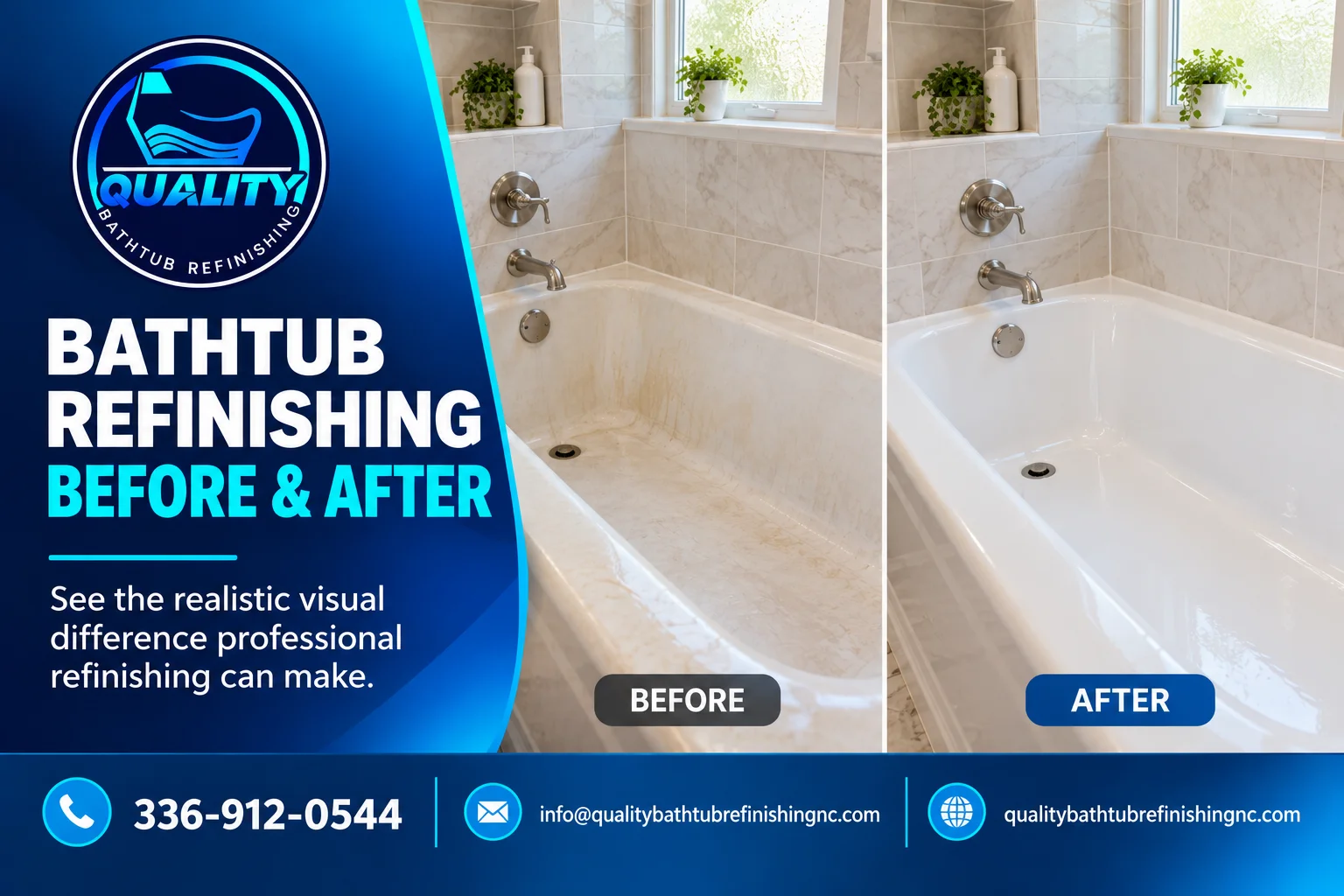
The honest answer is that it depends on the starting condition, but the type of change is consistent: refinishing restores the visible surface, so a tub that looked tired, dated, or worn generally comes out looking cleaner, more uniform, and more current. Common transformations include a dull, aged finish coming back to a renewed, more even appearance; a stained or discolored surface looking more uniform once it has been properly prepared and refinished; an outdated color, such as beige or almond, updated to a fresher color like white; and a surface showing minor wear looking noticeably improved.
What ties these together is that refinishing works on the surface. The more the tub’s problem is a surface-appearance problem, the more dramatic the before-and-after tends to look. A tub that is structurally sound but simply looks old is where refinishing shows its strongest visual change. A tub whose problems go deeper than the surface is a different situation, covered below. So before-and-after results are real and can be significant, but they track the starting condition rather than being uniform from tub to tub.
What can bathtub refinishing improve?

On the visual side, professional refinishing can improve a range of things: the color, the gloss and overall appearance, the uniformity of the surface, the look of minor scratches and surface wear, the appearance of staining once the surface is properly prepared, a worn or tired finish, and a generally outdated look. In short, it addresses how the surface looks, which is exactly what most homeowners are reacting to when they decide a tub looks old.
The important boundary is that these are surface-appearance improvements. Refinishing does not automatically repair structural problems, and a before-and-after photo of a good cosmetic result does not mean the process rebuilds a failing tub. Significant cracks, holes, substrate failure, or other serious damage may require repair or, in some cases, replacement, and those are separate from the surface restoration that produces the visible change. Keeping that distinction in mind is what separates a realistic expectation from an overpromise.
What bathtub problems may need repair before refinishing?
Some conditions have to be addressed before a refinish will look right or hold up, and understanding this explains why some before-and-after results are better than others. Problems that may need repair as a separate step before refinishing include deep cracks, holes, significant chips, rust or corrosion, substrate damage, a failed previous coating, and severe peeling or bubbling. In these cases, repair and refinishing can be two stages: the damage is made sound first, and then the surface is refinished over it.
This matters for the before-and-after because a finish applied over unaddressed damage tends to reveal or reproduce that damage, which is where poor results come from. A strong before-and-after usually reflects that any necessary repairs were done properly before the finish went on. This guide does not work through each repair in depth; our guides on repair versus refinishing and bathtub surface damage cover that, and the point here is simply that the condition going in shapes the result coming out.
Bathtub refinishing before and after: common examples
Rather than specific projects, here are the common starting conditions and the kind of visual change each tends to produce. These are general categories of result, not photographs of particular jobs.
Old, dull finish. A tub whose finish has gone flat and lifeless is one of the most rewarding before-and-afters, because refinishing restores gloss and evenness to a surface whose main problem is simply age and wear. The change is usually clear.
Stained or discolored surface. Refinishing can produce a much more uniform surface here, but the before-and-after depends on the staining being properly assessed and prepared first. Some discoloration is surface staining and some is the finish itself changing, and our stain removal guide covers telling those apart, which matters before a refinish.
Beige or almond bathtub. Updating a dated beige or almond tub to white is one of the most common and most striking before-and-afters, since it changes the whole feel of the bathroom. The result depends on preparation and even coverage; our guide on refinishing a bathtub white covers that specifically.
Scratched bathtub. Superficial surface wear can look noticeably improved after refinishing, while deeper scratches that reach past the finish may need to be addressed first, which our scratch repair guide covers. The before-and-after is stronger when the scratches were surface-level.
Chipped bathtub. Chips generally need to be repaired as part of the work for the finished surface to look right; our chip repair guide covers that. A good before-and-after on a chipped tub reflects that the chip was properly repaired, not just coated over.
Rusted bathtub. Rust and corrosion need to be assessed and addressed before a final finish goes on, because coating over active corrosion does not resolve it; our rust repair guide covers that. The before-and-after depends heavily on how the corrosion was handled.
These are illustrative categories of the results refinishing tends to produce. They are not presented as specific Quality Bathtub Refinishing NC projects; for real project photos and details, see the note in the client-input section.
Can refinishing make an old bathtub look new?
Refinishing can produce a significant visual improvement, and an old, tired tub can come out looking dramatically better, but “brand new” is a phrase worth being careful with. A more accurate way to put it: professional refinishing can substantially restore a tub’s appearance, and the result depends on the starting condition, any repairs, the quality of preparation, the coating system, and how the tub is maintained afterward.
Age alone does not determine how good the result will be; condition does. A sound older tub that is simply worn or dated often refinishes beautifully, while a tub with significant underlying damage is limited by that damage regardless of how the surface is finished. And the finished appearance is not frozen in time; how the tub is cared for afterward affects how new it continues to look. So the realistic claim is a big improvement in appearance on a suitable tub, not a guarantee that any tub will look factory-new. Whether a specific tub is a good candidate is covered in our guide on whether a tub can be refinished.
Why some before-and-after results look better than others
This is the most useful thing to understand when you are comparing photos, because it explains the variation you see. The quality of a before-and-after result depends on several factors working together:
- Starting condition. A tub whose problem is purely surface wear has more room for a dramatic, clean result than one with deeper damage.
- Substrate. The material and the soundness of the body underneath affect what the finish has to work with.
- Repair quality. Where repairs were needed, how well they were done shows in the final surface.
- Preparation. Thorough, even preparation is what lets the finish bond and look uniform.
- Coating compatibility. A system suited to the surface performs and looks better than a mismatched one.
- Application. Consistent, even application produces a smooth, uniform result.
- Curing. Proper curing is part of a finish that holds up and keeps looking right.
- Maintenance. How the tub is cared for afterward affects how the result ages.
No single one of these guarantees a perfect result on its own, and a weak link in any of them can show in the finished surface. The strongest before-and-afters are the ones where the tub was a good candidate, the preparation and any repairs were done properly, and the finish was applied and cured well. That is why two tubs that looked similar before refinishing can have different-looking results.
How to evaluate bathtub refinishing before-and-after photos
Photos are useful, but they can make a result look better or worse than it is, because lighting, camera angle, distance, white balance, how clean the bathroom was, surrounding fixtures, editing, cropping, and image resolution all affect the impression. This is not about accusing anyone of manipulating images; it is about comparing photos more intelligently. Here is a practical checklist for reading a before-and-after:
- Is it the same bathtub? The before and after should clearly be the same tub.
- Similar camera angle and distance. Compare shots taken from roughly the same position, not a wide “before” and a tight “after.”
- Similar lighting. Very different lighting can exaggerate the change.
- Look at the edges and corners. These are where application quality shows; check them in the after photo.
- Check the drain and overflow areas. These detailed areas are telling.
- Look at any repaired areas. If a chip or crack was repaired, see how it blends.
- Consistency across the surface. The finish should look even, without obvious patchiness.
- No suspicious cropping. Be cautious if key areas are cropped out of the after photo.
- Multiple examples, not one. A range of projects is more informative than a single striking image.
- Ask whether the photos are actual completed projects. Real, recent work is what you want to see.
The goal is not suspicion; it is to look past a flattering single image and judge whether the work is consistently good. A contractor who does solid work should be comfortable showing multiple examples and answering questions about them.
What should a professional bathtub refinishing result look like?
Without inventing a formal inspection standard, a good professional result generally has a relatively uniform appearance, consistent color, a smooth visual finish, clean edges, properly finished corners, no obvious peeling or bubbling, and no obvious overspray on surrounding surfaces like tile, fixtures, or walls. Those are reasonable things to look for in both the after photos and the finished work in person.
A word of caution in the other direction: not every minor visual variation means poor workmanship. Lighting and normal surface characteristics can create small differences that are not defects, and being unrealistically picky is as unhelpful as being uncritical. The sensible middle is to look for a finish that is clearly uniform, clean at the edges and corners, and free of obvious problems like peeling, bubbling, or overspray, and to ask about anything that genuinely looks off rather than assuming the worst about small variations.
How long does the new finish last?
The durability of the result, how long it keeps looking good, depends on the same factors that produce a good result in the first place: the condition of the substrate, the quality of preparation, the compatibility of the coating system, the quality of application, proper curing, ongoing cleaning and maintenance, and exposure to impact, abrasion, and moisture. A result that was done well and is cared for properly holds its appearance far longer than a rushed job or a neglected surface.
Quality Bathtub Refinishing NC’s guidance is that a refinished tub can be expected to last approximately 10 to 15 years with proper care. That is a company-specific expectation based on its own process and materials, and it should be read as a realistic expectation for well-executed work that is properly maintained, not as a universal industry guarantee or an assured result for every tub. For the before-and-after question, the practical point is that the impressive “after” is not permanent on its own; keeping it looking that way depends on care, which the next section covers.
How to protect the result after refinishing
Protecting the before-and-after result comes down to caring for the finish properly. In general, follow the care instructions your contractor provides, use appropriate non-abrasive cleaning methods, avoid abrasive pads and harsh practices that can damage or dull the finish, and follow any post-refinishing cure instructions during the early period after the work is done. Because coating systems differ, the care instructions supplied for your specific finish are the authority. Our maintenance guide covers day-to-day care, and the aftercare and curing guide covers the important early period, including how long to wait before using the tub. Good care is what keeps the “after” looking like the “after.”
Questions to ask a bathtub refinishing company about before-and-after photos
When a company shows you before-and-after photos, a few questions help you understand what you are looking at:
- Are these photos from your actual projects?
- Are the before and after photos of the same tub?
- What condition was the tub in before refinishing?
- Were any repairs required first?
- What type of tub material was it?
- How long ago was the work completed?
- What maintenance was recommended afterward?
- Can I see examples involving a tub similar to mine?
- Can you show examples of color changes, such as a tub taken to white?
- What warranty applies to the work?
Quality Bathtub Refinishing NC offers free estimates and a written warranty, so the estimate and warranty questions are reasonable to expect. The rest help you understand whether the photos reflect work like what your tub needs, which is more useful than an impressive but unrelated example.
When before-and-after photos are not enough
Photos show the visible result, but they do not show everything that matters, so they are one input rather than the whole decision. Beyond the images, it is worth considering the company’s process, the materials and coating system, how they approach preparation and repair, the warranty, the maintenance instructions they provide, their experience, their reviews, and the estimate for your specific tub. A great photo of someone else’s tub does not tell you how your particular tub, with its particular condition, will turn out, which is why an assessment of your own tub matters. This guide does not rank companies or tell you which to choose; it simply notes that the photos are a starting point, and the fuller picture comes from the process, the warranty, and an estimate for your own project. You can see the scope of the work on the bathtub refinishing services page.
Frequently asked questions
Does bathtub refinishing really work?
Yes, for its purpose, which is restoring the surface appearance of a sound tub. It can produce a significant visual improvement on a tub whose problems are surface-level, such as a dull, dated, stained, or worn finish. The result depends on the starting condition, preparation, any repairs, the coating system, and maintenance.
What does a refinished bathtub look like?
A well-refinished tub generally looks cleaner, more uniform, and more current, with consistent color and a smooth finish. How dramatic the change is depends on how the tub looked before; a tired or dated tub shows a bigger change than one that was already in decent shape.
Can refinishing make an old tub look new?
It can substantially restore an old tub’s appearance, and the improvement is often dramatic, but “brand new” is a strong phrase. The result depends on the tub’s condition, any repairs, preparation, the coating, and maintenance. A sound older tub that is simply worn often refinishes very well.
Can refinishing remove stains?
Refinishing applies a new finish over a prepared surface, so it can produce a more uniform, stain-free appearance once the surface is properly assessed and prepared. If a stain reflects a substrate issue or a failing surface, that should be addressed during preparation. Some discoloration is a cleaning matter first, which the stain removal guide covers.
Can refinishing change bathtub color?
Yes, refinishing can change a tub’s color, including updating a dated color to a fresher one. That is a common and often striking before-and-after. Our color change and white-refinishing guides cover the specifics of how the existing color affects the result.
Can a beige bathtub be refinished white?
Often, yes, and beige-to-white is one of the most common and most striking before-and-afters. The result depends on proper preparation and even coverage, and any staining or damage may need to be addressed first. The white-refinishing guide covers this in detail.
Can scratches be refinished?
Superficial surface scratches can look noticeably improved after refinishing, while deeper scratches that reach past the finish may need to be addressed first. The scratch repair guide covers how scratch depth affects the result.
Can chips be repaired before refinishing?
Yes, chips are generally repaired as part of the work so the finished surface looks right, and a good before-and-after on a chipped tub reflects that the chip was properly repaired rather than just coated over. The chip repair guide covers this.
Can rusted tubs be refinished?
Rust and corrosion need to be assessed and addressed before a final finish is applied, because coating over active corrosion does not resolve it. The before-and-after depends on how the corrosion was handled. The rust repair guide covers this.
How long does the new finish last?
Quality Bathtub Refinishing NC’s guidance is approximately 10 to 15 years with proper care, which is a company-specific expectation for well-executed work that is maintained properly, not a universal guarantee. Durability depends on preparation, the coating, application, curing, and ongoing care.
How long before the tub can be used?
The company’s guidance is that many jobs are completed in about a day, with general guidance to wait roughly 24 to 48 hours before normal use while the finish cures. These are guidance figures rather than a fixed rule, since cure time depends on the coating system and conditions. The aftercare and curing guide covers this in more detail.