What Should You Look for in a Bathtub Refinishing Company?
Choosing a bathtub refinishing company comes down to what you can verify before the work starts, not who has the loudest marketing. A refinished tub is only as good as the surface preparation underneath it, the coating system chosen for your specific tub, and the repairs handled before any finish goes on. Those things are hard to see once the job is done, so the time to evaluate a company is while you are still asking questions.
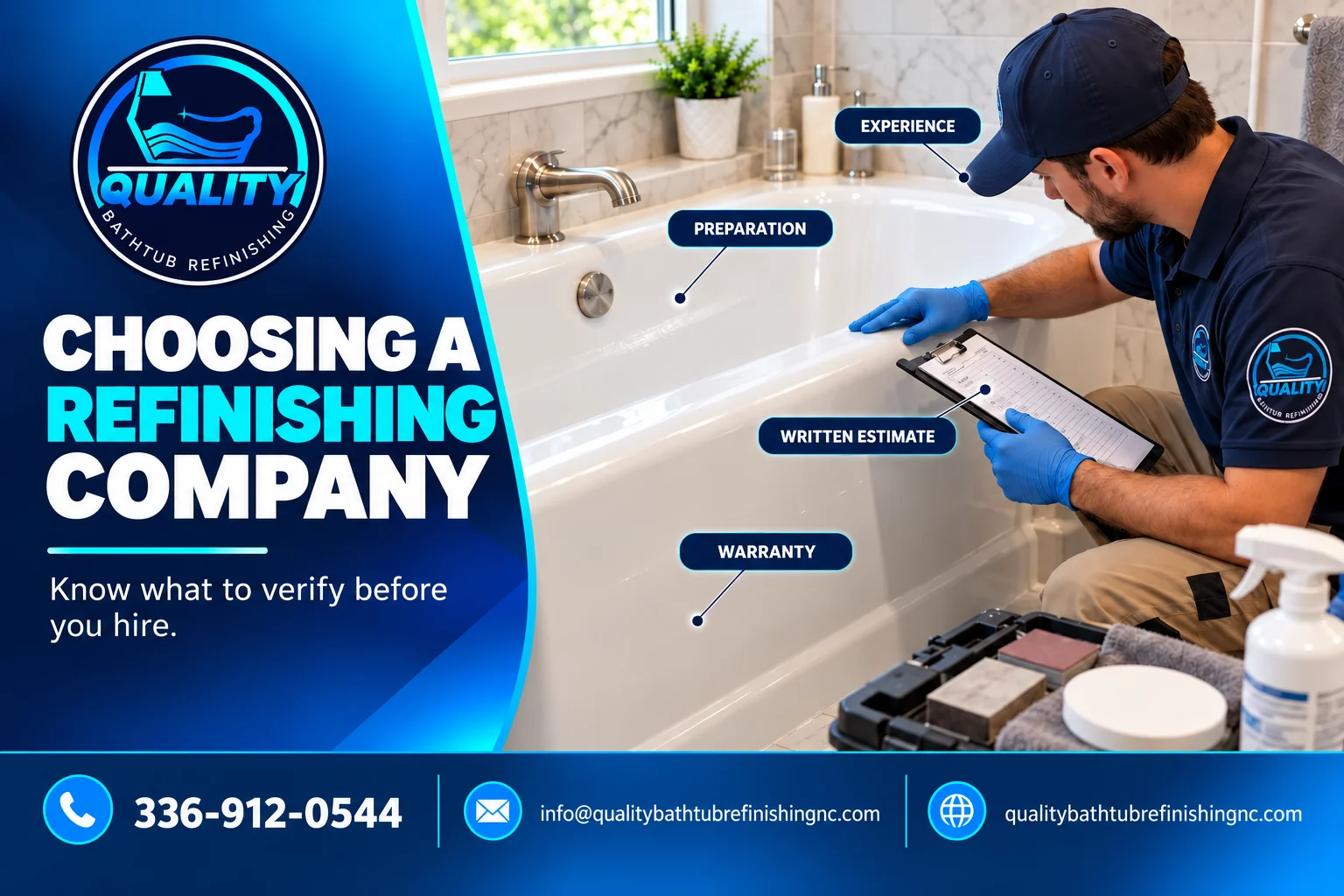
A useful evaluation looks at several areas together: relevant experience with refinishing (not just years in business), how the company prepares a surface, whether it can address chips, cracks, rust, and previous coating failures, how transparent it is about the coating system and your tub material, whether it can show real project examples, what the written estimate includes, what the warranty actually covers, what aftercare and cure guidance you receive, and how clearly the company communicates. No single one of these decides the question. Read together, they tell you whether a company understands the work and whether its offering matches what your bathroom needs.
The sections below walk through each area and give you specific questions to ask. The goal is not to hand you a scorecard or name a company to hire. It is to help you compare companies on what is actually included, so the decision stays yours.

1. Look for Experience With Bathtub Refinishing
Experience is worth asking about, but the useful version of the question is more specific than “how long have you been in business?” A company can be years old and still rarely refinish tubs. What matters more is relevant experience: refinishing work specifically, on tubs like yours, in conditions like yours.
There is a difference between “years in business” and “experience with bathtub refinishing and your specific tub material.” A general remodeling outfit that occasionally refinishes a tub is not the same as a company that refinishes surfaces regularly and understands how different substrates behave. Years alone do not prove quality, and a fixed number of years is not a reliable cutoff. Use experience as context, then confirm it with specifics.
Questions worth asking:
- How long have you been refinishing tubs specifically?
- How many similar projects have you completed?
- Have you worked with my tub material?
- Have you handled tubs with similar damage to mine?
If a company can describe the kind of work it does regularly and speak clearly about tubs like yours, that is more informative than a headline number of years.
2. Ask About Your Bathtub’s Material and Condition
Refinishing is not one process applied the same way to every tub. The material underneath affects how the surface is prepared and which coating system is appropriate. Common tub materials include porcelain over cast iron, porcelain over steel, fiberglass, acrylic, and cultured marble or similar solid surfaces. Each behaves differently, and a company should be comfortable identifying yours and explaining how it changes the approach.
Condition matters just as much as material. A tub with surface wear is a different job from one with deep chips, active rust, or a previous refinishing coat that is peeling. A company that assesses both material and condition before quoting is giving you a more realistic picture than one that quotes a flat number sight unseen.
If you are not sure whether your tub can be refinished at all, that is a reasonable first question to settle. Our guide on how to know if a bathtub can be refinished walks through the factors that affect suitability.
3. Ask What Preparation Is Included
Preparation is the part of refinishing that homeowners see least and that affects durability most. A finish applied over a surface that was not properly cleaned, deglossed, or repaired has less to bond to, which is a common reason coatings fail early. So it is fair to ask, in plain terms, what preparation the price includes.
Preparation methods vary by substrate and coating system, so there is no single universal process a company must follow. What you are listening for is whether the company can explain its preparation clearly and whether the estimate treats preparation as included work rather than an afterthought.
Questions worth asking:
- How is the surface prepared before the coating goes on?
- Is cleaning and decontamination included?
- Are damaged areas repaired as part of the job?
- Is old or failing coating removed where necessary?
- How are surrounding surfaces protected during the work?
For a fuller picture of what refinishing involves start to finish, see our bathtub refinishing process guide.
4. Find Out How Surface Damage Will Be Handled
Most tubs that get refinished have some damage: chips, cracks, holes, rust spots, scratches, or a previous coat that is peeling or bubbling. How a company handles that damage before refinishing is worth understanding, because the finish coat does not fix structural problems underneath it.
Some damage can be repaired before refinishing so the finished surface is smooth and sound. Other conditions may affect whether refinishing is the right choice at all, or whether repair should come first. The presence of damage does not automatically mean the tub needs replacing, but it does mean the company should be able to tell you how it plans to address what it finds.
Ask what happens if damage is discovered once preparation begins, since problems are sometimes only visible after the old surface is worked on. A clear answer to that question tells you the company has a plan rather than a surprise waiting.
To understand the difference between repairing damage and refinishing the whole surface, see bathtub repair vs refinishing, and for the kinds of damage refinishing does and does not address, see bathtub surface damage.
5. Ask About the Coating or Refinishing System
You do not need to become a coatings expert, but you should understand at a basic level what is being applied to your tub and why it suits your surface. A company that can explain its coating system in plain language, and confirm it is appropriate for your tub material, is easier to trust than one that treats the product as a secret.
Questions worth asking:
- What type of coating system do you use?
- Is it designed for bathtub surfaces?
- Is it compatible with my tub’s material?
- What preparation does the manufacturer require for that system?
- What maintenance does the manufacturer recommend afterward?
There is no single coating that is universally best for every tub, and you should be cautious of anyone who claims otherwise without support. Different substrates call for different approaches. What you want is a system that matches your tub and a company that can explain the match.
6. Look at Real Before-and-After Projects
Project photos are one of the few ways to see a company’s actual results before you commit. They are useful, but only if you look at them critically rather than taking a polished gallery at face value.
A checklist for evaluating project photos:
- Do the before and after images show the same tub?
- Is the camera angle comparable between them?
- Is the lighting adequate and reasonably consistent?
- Can you see edges, corners, and the areas that are hardest to finish well?
- Is it presented as an actual company project rather than a stock image?
- Is the tub’s original condition described?
- Is the material identified where possible?
- Is any repair work disclosed?
Asking how recently the work was completed is also fair, since a result that has held up over time tells you more than one photographed the day it was finished. For a deeper walkthrough of reading these images, see our guide on bathtub refinishing before and after. None of this is about accusing a company of manipulating photos. It is about knowing what a genuinely informative before-and-after looks like.
7. Read Reviews, But Look at the Details
Reviews can tell you things a company will not, especially about how it behaves during and after a job. They are useful for gauging communication, punctuality, cleanliness, workmanship, customer service, and follow-up. The specifics in a review often matter more than the star rating attached to it.
Reviews also have limits. A single number does not prove quality, review counts can reflect how long a company has been operating as much as how good it is, and individual experiences vary. Read for patterns and detail rather than treating a rating as a verdict. A review that describes how a company handled a problem tells you more than a five-star review with no explanation.
If you are looking at reviews for Quality Bathtub Refinishing NC or any company, treat what you read as current only if it is dated, and give more weight to specific, detailed accounts than to raw scores.
8. Get a Written Estimate
A written estimate protects both you and the company by putting the scope in one place you can both refer back to. Verbal quotes leave too much room for a later disagreement about what was and was not included.
A useful estimate generally makes clear:
- The scope of work
- What preparation is included
- What repairs are included
- The finish or coating being applied
- The timeline
- The price
- The warranty
- Cure and return-to-use guidance
Not every estimate is legally required to contain every one of these, and formats vary between companies. But an estimate that spells these things out gives you a real basis for comparison, and one that leaves most of them vague is harder to hold anyone to.
9. Understand the Warranty
A warranty is only as useful as its terms, so it is worth reading past the headline promise. Two companies can both advertise a warranty and cover very different things.
Questions worth asking:
- How long is the warranty?
- What exactly does it cover?
- Are peeling and chipping covered?
- What exclusions apply?
- Are there maintenance requirements you must follow to keep it valid?
- Who handles a warranty claim if something goes wrong?
There is no single industry-standard warranty that every homeowner should expect, so the point is not to demand a particular length or terms. It is to understand what you are actually being offered and what conditions come with it. A warranty that requires specific aftercare, for example, is common, and knowing that upfront helps you keep the coverage intact.
10. Ask About Aftercare and Cure Time
A refinished surface needs time to cure before normal use, and it needs the right care afterward to last. A company that hands you clear aftercare guidance is giving you part of what determines how long the finish holds up.
Ask about:
- When the tub can be used again
- What cleaning products are recommended
- What cleaning methods or products to avoid
- How to prevent premature damage to the new surface
Clear, written instructions are better than a verbal “just be gentle for a while.” For the details of both curing and long-term upkeep, see our guides on bathtub refinishing aftercare and curing and bathtub refinishing maintenance.
11. Ask About Safety and Protecting Your Home
Refinishing involves products and processes that call for sensible safety practices, both for the people doing the work and for your home. You do not need technical chemical knowledge to ask reasonable questions about how a company manages this.
Fair questions include how the company handles ventilation during the work, what protective equipment the workers use, how surrounding bathroom surfaces and fixtures are protected, when occupants should stay out of the space, and when it is safe to return to normal use. Federal safety authorities including the National Institute for Occupational Safety and Health (NIOSH), the Occupational Safety and Health Administration (OSHA), and the Environmental Protection Agency (EPA) publish guidance on the hazards associated with some refinishing products and the controls that reduce risk. A company that takes ventilation and protection seriously, rather than assuming an open window handles everything, is applying the kind of caution these authorities describe.
12. Ask About Insurance and Licensing Where Relevant
Licensing is an area where it helps to be precise, because requirements depend on the type and scale of work rather than applying uniformly to everyone. In North Carolina, the general contractor license administered by the North Carolina Licensing Board for General Contractors is required when the cost of the undertaking is $40,000 or more, under state law (G.S. 87-1). That threshold is aimed at larger construction and improvement projects. A typical bathtub refinishing job falls well below it, so refinishing work by itself does not usually trigger the general contractor license requirement.
That does not mean licensing is never relevant. Requirements can depend on the type of work, the contract value, the overall project scope, the jurisdiction, and applicable trade or construction rules, and local rules can differ from state ones. Requirements can also change, so you should verify current North Carolina requirements yourself for your specific situation rather than relying on a general statement. If a company is doing broader bathroom remodeling alongside refinishing, or the total project is large, the picture can change.
Insurance is a separate question worth asking about regardless of licensing. Reasonable questions to a company include:
- Are you properly licensed for the work you perform?
- Are you insured?
- Can you provide documentation if I ask?
Treat a company as licensed or insured only if it can show you, not because it says so in an ad.
13. Compare Quotes by Scope, Not Just Price

When you have more than one estimate, the prices will often differ, and the difference frequently reflects different scopes rather than one company being overpriced. Comparing the bottom-line numbers alone can be misleading.
Line the estimates up and compare what each one actually includes:
- Preparation
- Repairs
- The coating system
- Warranty terms
- Timeline
- Aftercare guidance
- Cleanup
- Exclusions
A lower quote that skips repairs or minimal preparation is not really cheaper if it fails sooner, and a higher quote is not automatically better. The cheapest quote is not always a bad one, and the most expensive is not always the best. The useful comparison is what is included for the price, so you are weighing like against like.
Questions to Ask Before Hiring a Bathtub Refinishing Company
You can bring this list with you when you talk to a company. Expect answers to vary, because tubs and situations vary. What you are listening for is clarity and specifics, not a single “correct” script.
- What material is my bathtub?
- Is it suitable for refinishing?
- What preparation is required?
- Are repairs included in the price?
- What happens if you find damage after preparation begins?
- What coating system do you use?
- Is that system appropriate for my tub material?
- How long does the work normally take?
- How long before I can use the tub again?
- What maintenance do you recommend afterward?
- What does the warranty cover, and for how long?
- Can I see actual before-and-after projects?
- Can you provide a written estimate?
- Are you licensed and insured where applicable?
- How do you protect the surrounding surfaces in my bathroom?
Bathtub Refinishing Company Red Flags to Investigate
None of the items below prove a company is dishonest or incompetent on their own. Each is a reason to ask more questions before you decide.
- Unwillingness to put the scope of work in writing may warrant additional questions.
- Vague or evasive answers about how the surface will be prepared are a reason to investigate further.
- No explanation of how repairs will be handled before refinishing is worth pressing on.
- Refusal to discuss the coating system at all may warrant additional questions.
- No clear warranty terms is a reason to ask for them in writing.
- Pressure to pay in full immediately, before work is agreed, is a reason to slow down.
- Promises that sound unrealistic for the price or timeline are worth questioning.
- Inability to explain cure time or aftercare is a reason to investigate further.
- Unwillingness to show any legitimate project examples may warrant additional questions.
If a company answers these questions openly, the concern often clears up. If it cannot or will not, that tells you something too.
How to Compare Two or More Bathtub Refinishing Companies
Rather than scoring companies, use a shared set of questions and compare the answers side by side. This keeps the comparison about what each company actually offers.
| Criterion | Questions to Ask |
| Experience | Relevant bathtub refinishing projects? |
| Material knowledge | Experience with your tub material? |
| Preparation | What preparation is included? |
| Repairs | Are chips, cracks, and rust addressed? |
| Coating system | What type of system is used, and is it suited to your tub? |
| Photos | Actual before-and-after project examples? |
| Estimate | Written scope? |
| Warranty | Duration and exclusions? |
| Cure time | When can the tub be used? |
| Aftercare | Written maintenance instructions? |
| Safety | How are workers and occupants protected? |
| Insurance/licensing | What applies in your jurisdiction? |
Fill in each company’s answers and look at where they differ. The differences that matter are in scope and clarity, not in who gives the most confident sales pitch.
Choosing a Local Bathtub Refinishing Company in North Carolina
If you are comparing local options, the same framework applies. Quality Bathtub Refinishing NC lists bathtub refinishing along with shower, sink, countertop, and ceramic tile refinishing and fiberglass tub repair among its services, and it publishes service-area information for the Greensboro and broader Piedmont Triad region. The company states that it offers free estimates and provides a written warranty, and it describes a typical one-day project timeline with return-to-use guidance for the following period.
Homeowners can review the company’s stated services, estimate process, warranty information, and project examples when evaluating whether its offering matches their needs. Details such as the exact warranty duration, the specific coating system used, and licensing or insurance documentation are best confirmed directly with the company, using the same questions above. You can start with the bathtub refinishing services page and the service areas information to see what is offered and where.
Frequently Asked Questions
How do I choose a bathtub refinishing company?
Evaluate several things together: relevant refinishing experience, how the surface is prepared, whether damage and repairs are handled, how transparent the company is about the coating system and your tub material, real project photos, a written estimate, warranty terms, aftercare guidance, and clear communication. Compare companies on what is actually included rather than on price or marketing alone.
How many years of experience should a bathtub refinisher have?
There is no universal minimum, and years in business alone do not prove quality. Relevant experience matters more: how regularly the company refinishes tubs, whether it has worked with your tub material, and whether it has handled similar damage. Ask for specifics rather than relying on a headline number.
Should I ask to see before-and-after photos?
Yes, and it helps to look at them critically. Check that the before and after show the same tub, at a comparable angle and with adequate lighting, that edges and corners are visible, and that the original condition and any repairs are described. Recent, well-documented examples are more informative than a polished gallery with no detail.
What should a bathtub refinishing estimate include?
A useful estimate generally makes clear the scope of work, what preparation and repairs are included, the coating being applied, the timeline, the price, the warranty, and cure or return-to-use guidance. Not every item is legally required, but an estimate that spells these out is much easier to compare and to hold a company to.
What should a bathtub refinishing warranty cover?
Read the warranty for its duration, exactly what is covered, whether peeling and chipping are included, what exclusions apply, whether specific maintenance is required to keep it valid, and who handles a claim. There is no single industry standard, so the goal is to understand what you are actually being offered rather than to expect particular terms.
Should the contractor repair chips and cracks before refinishing?
Damage is usually addressed before the finish coat, because the coating does not fix structural problems underneath it. Some damage can be repaired before refinishing, while other conditions may affect whether refinishing is the right choice. Ask how the company handles chips, cracks, rust, and any damage found once preparation begins.
How do I know if a refinishing company is using an appropriate coating system?
Ask what type of system it uses, whether it is designed for bathtub surfaces, and whether it is compatible with your tub material. A company should be able to explain this in plain language and point to the manufacturer’s preparation and maintenance guidance. Be cautious of anyone claiming one product is universally best without support.
Should I get more than one quote?
Getting more than one estimate helps, mainly because it lets you compare scope. Prices often differ because the work included differs. Compare preparation, repairs, coating system, warranty, timeline, and aftercare rather than only the bottom-line number.
How long does bathtub refinishing take?
It varies by the tub, its condition, and the coating system. Quality Bathtub Refinishing NC describes a typical one-day project for the refinishing itself, but you should confirm the timeline for your specific tub with any company you consider, since preparation and repairs can affect it.
How long before I can use the tub?
Refinished surfaces need time to cure before normal use. Quality Bathtub Refinishing NC provides return-to-use guidance for the period after the work, and cure times differ by system, so ask each company for its specific instructions. Following the aftercare guidance is part of how the finish lasts.
What should I ask about cleaning and maintenance?
Ask which cleaning products are recommended, which methods or products to avoid, when you can resume normal cleaning, and how to prevent premature damage. Written aftercare instructions are more reliable than verbal advice, and following them is often tied to keeping a warranty valid.
Do bathtub refinishing contractors need a license in North Carolina?
North Carolina’s general contractor license is required when the cost of the undertaking is $40,000 or more (G.S. 87-1), a threshold aimed at larger construction projects. A typical bathtub refinishing job falls well below that, so refinishing by itself does not usually trigger that requirement. Requirements can depend on the work, its value, and the jurisdiction, and they can change, so verify current North Carolina requirements for your situation and ask any company about its licensing and insurance directly.