
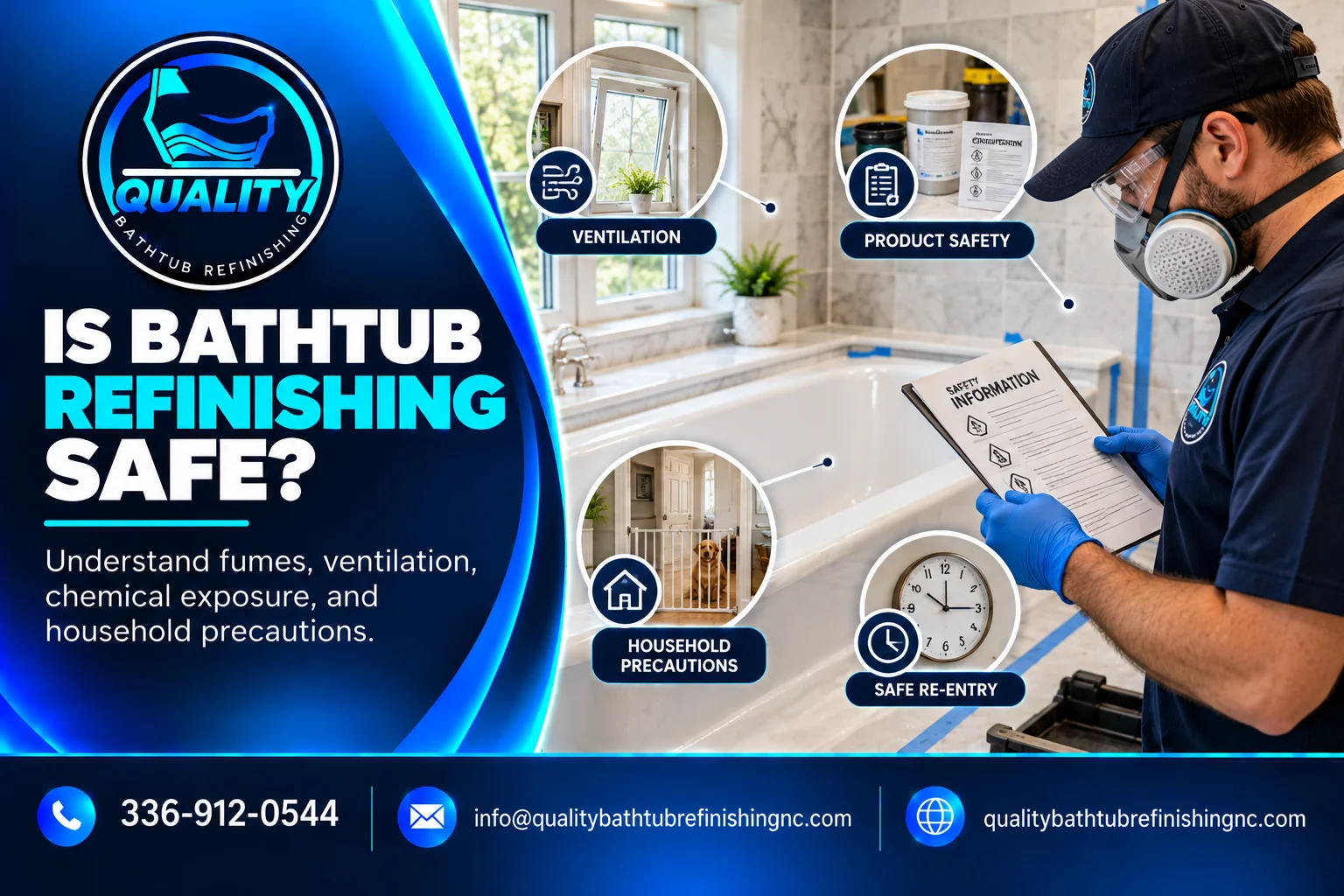
Is Professional Bathtub Refinishing Safe?
It can be, when a professional uses appropriate products with proper exposure controls and worker protection, but the safety profile depends on the specific coating system and chemicals involved. There is no single answer that applies to every job, because different products carry different hazards and call for different precautions. This is why the product and its documentation matter more than any general reassurance.
Professional application is not inherently safe or unsafe; it is safe to the extent that the right precautions are taken for the specific products. A reputable contractor identifies the products being used, follows the manufacturer’s safety instructions and Safety Data Sheet, controls exposure appropriately, and communicates what your household should do. The rest of this guide explains the specific issues, chemicals, fumes, methylene chloride, ventilation, re-entry, so you know what to ask and what to expect, rather than relying on a blanket claim in either direction.
What Chemicals Are Used in Bathtub Refinishing?
Bathtub refinishing systems can involve different chemical products, including coatings, primers, cleaners, and surface-preparation products, and these vary from one company and system to another. There is no single universal formula, so the accurate thing to say is that the specific products determine the specific hazards. That is why asking which products will be used, and reviewing the Safety Data Sheet (SDS), is the reliable way to understand a job’s safety profile.
Because products differ, do not assume your job involves the same chemicals as any other, and do not assume a product is harmless simply because it is modern or low-odor. The SDS for the actual product is the authoritative source for its hazards, handling, and exposure controls. A professional should be able to tell you what they are using and share the relevant safety documentation. This guide does not list ingredients or name a product, because that depends entirely on the system in use.
Are Bathtub Refinishing Fumes Dangerous?
Some refinishing products produce noticeable odors and airborne chemical exposure during and after application, and whether that exposure is hazardous depends on the specific product, the conditions, and the controls in place. The important point is that odor and actual exposure are not the same thing: a strong smell does not by itself prove the air is dangerous, and, just as importantly, the absence of a strong smell does not prove it is safe.
This is why you cannot rely on your nose to decide whether a room is safe to enter. Some hazardous vapors are not reliably judged by smell, and exposure risk depends on the chemical, the ventilation, and how much is in the air, not on how strong the odor is. The safe approach is to follow the product-specific re-entry guidance from the contractor and manufacturer rather than waiting until the smell fades. The methylene chloride issue below is the clearest example of why smell is not a safety gauge.
Methylene Chloride and Bathtub Refinishing Safety
Methylene chloride is a solvent that was historically used in some paint strippers for bathtub refinishing and has been linked to serious health risks. NIOSH documented worker fatalities associated with methylene chloride-based strippers used in tub refinishing, and warned that ordinary residential ventilation, an open window or a standard bathroom fan, is not adequate protection against its vapor. This is the central reason professional exposure controls differ so much from simply airing out a room.
The regulatory position has since changed, and the dates matter. On May 8, 2024, the U.S. Environmental Protection Agency published a final rule under the Toxic Substances Control Act regulating methylene chloride, effective July 8, 2024. The rule prohibits the manufacture, processing, and distribution of methylene chloride for all consumer uses, and prohibits most industrial and commercial uses, allowing only a narrow set of uses to continue under a strict Workplace Chemical Protection Program with a low exposure limit. Bathtub refinishing is not among those narrowly allowed uses, and the consumer prohibition phases in over roughly 450 days from the effective date.
Two honest takeaways follow. First, historical use and current law are different: methylene chloride strippers caused documented harm in the past, and current regulation restricts the chemical heavily. Second, and just as important, the restriction on methylene chloride does not make refinishing automatically safe, because other products have their own hazards. The right question is not only “does it contain methylene chloride?” but “what product is being used, and how is exposure controlled?” This guide does not provide any instructions for handling methylene chloride or other hazardous chemicals; that is professional work governed by occupational safety rules.

Does Bathtub Refinishing Require Special Ventilation?
Often yes, and the key point is that appropriate ventilation and exposure control depend on the specific product, not on a one-size-fits-all household fix. Opening a window or running an ordinary bathroom fan should not be treated as a universal safety solution, because some products require far more than residential airflow to control exposure. NIOSH made exactly this point about methylene chloride: normal home ventilation was not adequate.
Rather than prescribe a ventilation setup, which depends on the chemicals and the manufacturer’s instructions, the practical step is to ask the contractor how they control exposure for the product they are using. Professional exposure control can involve engineering controls and worker protection that go well beyond opening a window, and the appropriate approach is set by the product’s documentation and applicable safety requirements. If a company cannot explain how it manages exposure, that is a reasonable thing to press on.
Is It Safe to Stay in the House During Bathtub Refinishing?
It depends, and there is no universal answer. Whether you can remain in the home during the work depends on the products being used, your home’s layout, where the work area is, the ventilation and exposure controls in place, and the manufacturer’s instructions and any applicable safety requirements. Some situations may allow household members to stay elsewhere in the property; others may call for different arrangements.
Because it varies, the reliable step is to ask the contractor for product-specific guidance before the appointment: whether you can remain in the home, which areas to avoid, and for how long. Do not assume you must always leave, and do not assume you can always stay. The correct answer comes from the specific product and the contractor’s exposure-control approach, which is why knowing the product and its SDS in advance is so useful.
Should Children and Pets Stay Away During Bathtub Refinishing?
Yes. Children and pets should be kept out of the active work area during refinishing, and household exposure should be considered beyond just the immediate room. Children and pets can be more sensitive to chemical exposure and are less able to follow precautions, so keeping them clear of the work area, and following the contractor’s guidance on the surrounding space, is sensible.
The specifics, how far away, for how long, and whether they should be out of the home entirely, depend on the product and the contractor’s exposure-control measures, so this guide will not invent exact distances or times. Ask the contractor for product-specific instructions about children and pets, including re-entry timing. A professional should be able to explain the access restrictions and why they apply.
What Safety Precautions Should a Professional Refinishing Company Take?
A professional company’s safety approach generally rests on identifying the products, following their documentation, controlling exposure, and protecting both workers and your household. In general principle, that includes:
- Identifying the specific products and coatings being used.
- Reviewing the manufacturer’s instructions and the Safety Data Sheet.
- Assessing the exposure hazards for those products.
- Using appropriate engineering and exposure controls.
- Protecting workers with suitable measures, including following applicable OSHA requirements such as the methylene chloride standard where relevant.
- Communicating household precautions clearly.
- Providing clear re-entry instructions.
These are general professional principles, not a description of any specific company’s procedure. This guide does not claim that Quality Bathtub Refinishing NC follows a particular protocol, because that is not something to assert without the company’s confirmation (see the client input section). What you can reasonably expect of any professional is that they can explain their products and how they control exposure.
How Long Should You Stay Out of the Bathroom After Refinishing?
Follow the product-specific re-entry instructions your contractor gives you, rather than a fixed number. It helps to separate several different timeframes that are easy to confuse: the application time (while the technician works), the drying time (the surface setting), the curing time (the coating reaching full hardness), odor dissipation, and the product-specific re-entry window for safe occupancy. These are not interchangeable.
Quality Bathtub Refinishing NC has generally described return-to-use guidance of about 24 to 48 hours before using a refinished bathtub. Treat that as general guidance for using the tub, not as a universal clearance period for chemical exposure, and not as the same thing as odor fading. The actual safe re-entry timing is set by the product and the contractor’s instructions. For the detail on curing and returning the tub to use, see our aftercare and curing guide; the safety point here is simply that you should get, and follow, specific re-entry guidance rather than guessing from the smell.

Questions to Ask Before Hiring a Bathtub Refinishing Company
These safety-specific questions help you understand a job’s exposure profile before it starts:
- Which refinishing products will you use?
- Can I review the product’s Safety Data Sheet?
- Does the product contain methylene chloride?
- What safety instructions does the manufacturer provide?
- What exposure-control measures are appropriate for this product?
- What precautions should my household take?
- Should children and pets stay away from the work area, and how far?
- Can household members remain elsewhere in the property during the work?
- How will you communicate re-entry instructions?
- How long should I wait before using the bathtub?
These focus on safety. For evaluating a contractor more broadly, see how to choose a bathtub refinishing company and its wider checklist, and for getting the bathroom ready, see the bathtub refinishing preparation guide.
How to Make an Informed Decision About Bathtub Refinishing Safety
You can make a sound decision by focusing on a few practical things rather than a blanket judgment about whether refinishing is “safe.” In short:
- Find out which products will be used.
- Ask for the product-specific safety documentation (the SDS).
- Understand how the contractor controls exposure.
- Follow the household access restrictions during the work.
- Get clear, product-specific re-entry instructions.
- Do not rely on smell alone to decide whether a room is safe.
Handled this way, the safety question becomes answerable for your specific job rather than hypothetical. A professional who can name their products, explain exposure control, and give clear re-entry guidance is demonstrating the kind of safety awareness that matters. If you are planning a project, you can learn about the company’s professional bathtub refinishing services and request a free estimate, then raise the safety questions above.
Frequently Asked Questions
Is bathtub refinishing safe for homeowners?
It can be when a professional uses appropriate products with proper exposure controls and provides clear household and re-entry instructions. However, it is not automatically safe. Safety depends on the chemicals, conditions, and controls. Ask which products are used, how exposure is controlled, and when it is safe to return and use the bathtub.
Are bathtub refinishing fumes toxic?
Some products produce chemical fumes that can be hazardous depending on the product, conditions, and controls. Odor and exposure are not the same, so a strong smell does not automatically prove danger and a faint smell does not establish safety. Follow product-specific re-entry guidance rather than judging by smell.
Does bathtub refinishing use methylene chloride?
Historically, some bathtub refinishing strippers contained methylene chloride, which NIOSH linked to worker fatalities. The EPA’s 2024 final rule prohibits consumer uses and most commercial uses, subject to phased compliance dates and limited exceptions. Do not assume a particular product’s contents. Ask the contractor and review the SDS.
Can I stay in my house during bathtub refinishing?
It depends on the products, the home’s layout, the work area, and the exposure controls. Some projects may allow household members to remain elsewhere in the property, while others may require different arrangements. Ask the contractor for product-specific instructions before the appointment.
Should pets leave during bathtub refinishing?
Pets should be kept out of the active work area. Depending on the chemicals and exposure controls, they may need to remain farther away or outside the property. Ask the contractor where pets should stay and when they may safely return.
Is it safe to sleep in the house after bathtub refinishing?
That depends on the product, exposure controls, and contractor’s re-entry guidance. Do not assume that fading odors mean the home is safe for sleeping. Ask for specific occupancy instructions and follow them.
How long do bathtub refinishing fumes last?
It varies according to the product, ventilation, and conditions. There is no universal timeframe, and the disappearance of an odor is not the same as safe exposure levels. Follow the contractor’s product-specific guidance about ventilation and occupancy.
Does opening a window make bathtub refinishing safe?
Not necessarily. Opening a window or running an ordinary bathroom fan is not a universal safety solution. NIOSH specifically warned that normal residential ventilation is inadequate against methylene chloride vapor. Appropriate exposure controls depend on the actual product.
Can I use the bathroom immediately after refinishing?
The refinished bathtub should not be used until the specified curing period has passed. The bathroom may also have separate safe re-entry requirements. Quality Bathtub Refinishing NC generally describes approximately 24 to 48 hours before bathtub use, but follow your contractor’s specific instructions.
How can I find out which chemicals a contractor uses?
Ask the contractor which products will be used and request their Safety Data Sheets. These documents explain product hazards, handling precautions, and exposure-control requirements. A professional should be able to identify the products and provide relevant safety information.
Conclusion
Bathtub refinishing safety depends on the chemicals used, how exposure is controlled, and whether appropriate household precautions and re-entry instructions are followed.
The historical risks associated with methylene chloride demonstrate why chemical safety should be taken seriously. Current EPA restrictions address that particular substance, but other refinishing products still have their own safety requirements.
Homeowners should ask about the products, review the relevant SDS documents, understand ventilation and exposure controls, keep children and pets away from restricted areas, and follow specific re-entry instructions.
The goal is not to assume that refinishing is always dangerous or always harmless. It is to make an informed decision based on the actual work being performed.