
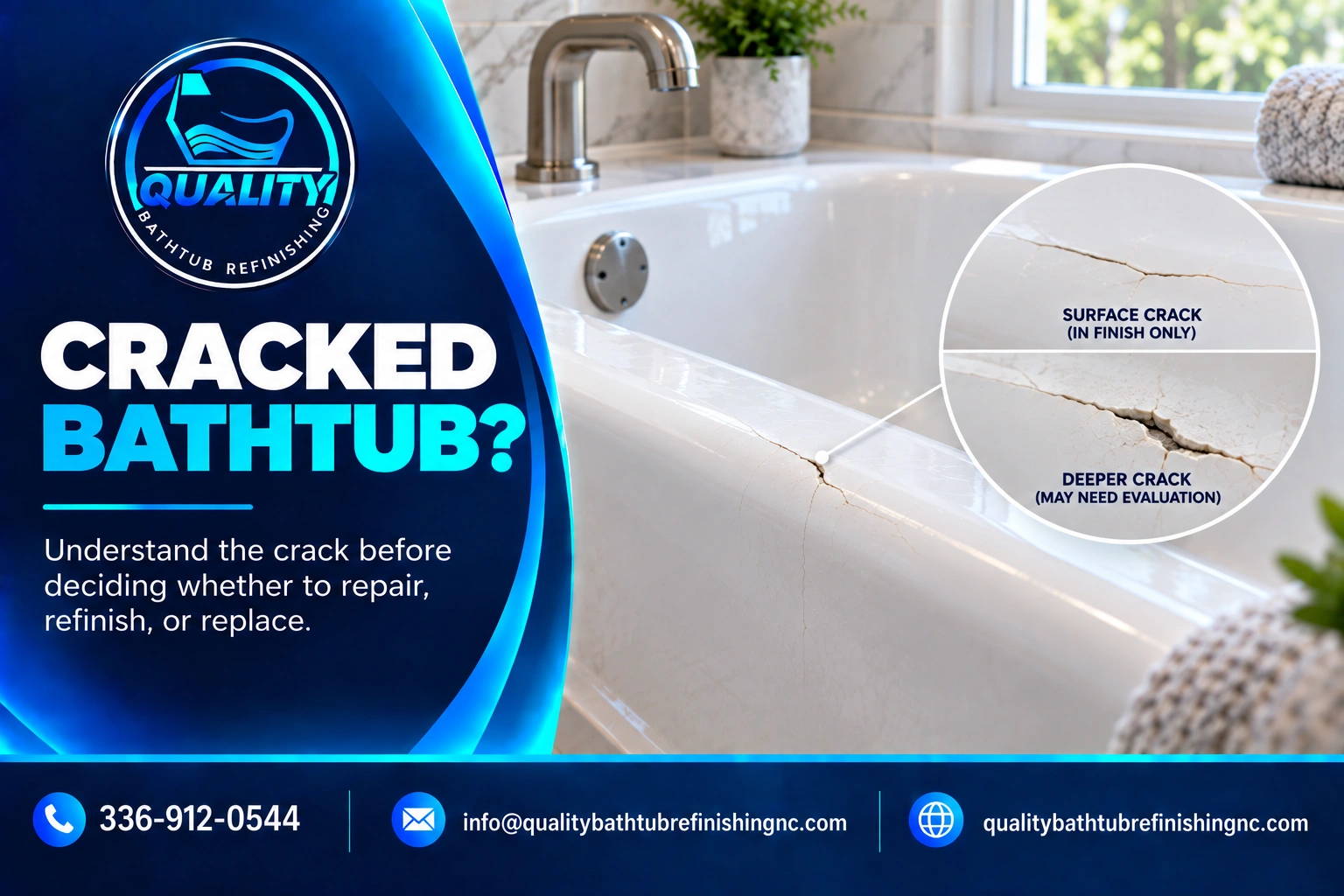
What does a crack in a bathtub mean?
A crack is a line or fracture through a surface or the material beneath it. That makes it different from a chip, which is a spot where a piece of the surface has broken away, and different from a scratch, which is a line worn into the surface. A crack is a split, and the reason it deserves more careful thought than a chip is that a crack can, in some cases, extend below the visible surface into the tub’s material, where it may have implications a chip usually does not.
The honest starting point is that a crack does not tell you its own seriousness just by being visible. A fine crack in a surface finish and a crack that runs through the body of the tub can look similar at a glance but mean very different things. The seriousness depends on the material, the depth, the location, whether it is moving or widening, whether there is surrounding damage, and whether it reaches the substrate. This guide is specifically about cracks: what causes them, how they differ from other damage, how to think about whether one may be surface-level or more serious, whether it can be repaired, and when replacement enters the picture. For the full range of tub damage types, our guide to bathtub surface damage covers the broader catalog.
Why do bathtubs crack?
There is rarely one universal cause, and a crack’s appearance alone does not reliably reveal why it happened. That said, several factors are commonly associated with cracking, and understanding them helps explain why cracks show up where they do:
- Impact, from a heavy or hard object striking the surface with enough force to fracture it rather than just chip it.
- Aging or material deterioration over many years of use.
- Flexing or movement, particularly on materials that can give under weight, which can stress a surface over time.
- Inadequate support beneath the tub, so the floor of the tub flexes more than it should under normal use.
- Installation-related issues that leave the tub without proper backing or bedding.
- Thermal or environmental stresses in some cases.
- Previous damage that has propagated, or improper earlier repairs that did not hold.
- Material-specific vulnerabilities, since different materials fail in different ways.
For fiberglass and acrylic tubs, flexing or movement can be relevant in some cases, because these materials are lighter and can give under weight, but you should not diagnose the cause from a crack’s appearance alone. For porcelain and enameled surfaces, it is worth distinguishing a crack in the finish from damage to the underlying tub, because those are different situations. In every case, the cause is best confirmed by looking at the specific tub rather than assumed.
Crack vs. chip: what’s the difference?
These two are worth separating clearly, because they often call for different thinking. A chip is generally a localized area where finish or material has been removed, leaving a small crater; our dedicated guide on repairing a chipped tub covers that specific case. A crack is a line or fracture through the surface or material, and it can behave differently because it may extend, may move, and may reach the substrate.
The practical difference: a chip is usually about a missing piece of surface in one spot, while a crack raises the additional question of how deep it goes and whether it involves the tub’s structure. That is not to say every crack is serious, many are not, but a crack introduces a dimension a chip usually does not: the possibility of movement and depth. Because of that, the rest of this guide spends more time on how to think about a crack’s seriousness and when a professional should look at it.
Does the bathtub material matter?
Yes, and with cracks it matters a great deal, because the same visible crack can have different implications depending on what is underneath. Identifying the material comes first. This is an overview; the fuller material-by-material picture is in our guide on determining whether a tub can be refinished.
Porcelain and enamel
Porcelain and enameled surfaces are hard and glassy. It is important to distinguish fine surface cracking in the finish, sometimes called crazing, from a crack that involves the tub beneath. Surface-level crazing may be a finish issue, while a crack that extends into the underlying material is a different and potentially more significant situation. Telling those apart is not always possible by eye, which is a common reason to have an enamel crack looked at.
Cast iron
Cast iron tubs have an enamel surface over a heavy, rigid iron body. That rigidity is why these tubs are so solid, but a crack through the enamel into the iron, or a crack in the iron itself, is a serious matter and not a routine surface repair. Because the body is so substantial, cast iron cracks are less common from ordinary flexing, but when they occur they warrant professional assessment.
Fiberglass
Fiberglass tubs are lighter and more flexible, and flexing is one of the factors that can be associated with cracking in these tubs, sometimes related to support beneath the tub. A crack in a fiberglass tub can involve the gel-coat surface, the fiberglass material, or both. Because fiberglass cracking often connects to the material itself rather than only the finish, this is frequently a material-repair question, and the company’s fiberglass tub repair service is the relevant resource for fiberglass-specific damage.
Acrylic
Acrylic tubs are also lighter and can flex, and like fiberglass they can crack in ways connected to movement or support. Acrylic is variable, and whether and how a crack can be addressed depends on the specific surface and situation, so it is a material where professional evaluation is especially worthwhile.
Other manufactured tub surfaces
Cultured marble and other manufactured surfaces have their own behaviors and considerations. As with acrylic, the appropriate response to a crack depends on the specific material and condition rather than a single rule.
The theme across all materials: a crack’s meaning depends on the substrate beneath it, which is why identifying the material and having the crack assessed matters more with cracks than with most other surface issues.
How to tell whether a bathtub crack needs professional attention
There is no way to conclusively diagnose a tub’s structural condition from a checklist at home, but there are observations that help you understand why a professional inspection may be warranted. Consider:
- The location of the crack (floor of the tub, wall, near a fixture, near an edge).
- The length of the crack.
- Whether it appears to be widening or lengthening over time.
- Whether the surface flexes or gives when you press near it.
- Whether there is surrounding damage.
- Whether water can reach the material beneath the crack.
- Whether there are any signs of leakage (water below the tub, dampness, staining on a ceiling below).
- Whether the tub moves under normal use.
- Whether the crack appeared after an impact.
- Whether there has been a previous repair in that area.
These observations can help identify why a professional inspection may be warranted, but they do not establish the structural condition of the tub by themselves. A crack that is short, stable, and confined to a surface finish is a different conversation from one that is lengthening, sits in a flexing area, or shows signs of water getting underneath. When several of these point toward possible movement, depth, or moisture, that is the signal to have it assessed rather than to keep guessing. Quality Bathtub Refinishing NC offers free estimates, which is a practical way to get that assessment.
When to stop using a cracked tub
This deserves a measured answer rather than a blanket rule. There is no universal law that a cracked tub can never be used, and many minor surface cracks are not an immediate safety issue. At the same time, some situations do call for caution. If there are signs of active leakage, significant movement of the tub under use, apparent major structural damage, a crack that is rapidly worsening, or damage that could compromise safe use, it is sensible to stop using the tub until it has been assessed appropriately. Continuing to use a tub in those conditions risks worsening the damage or allowing water to reach areas it should not. The reasonable approach is not alarm, but attention: if the crack seems minor and stable, an assessment can be scheduled without panic, and if any of the warning signs above are present, pausing use until a professional has looked at it is the prudent move.
Can a cracked bathtub be repaired?
Sometimes, and the honest answer depends heavily on the specifics. Some cracks can be repaired; others indicate a problem that a surface repair will not resolve. What determines it is the combination of factors this guide keeps returning to: the material, the crack’s depth and length, its location, whether it is moving, whether it reaches the substrate, and the tub’s overall condition.
A crack that is confined to a surface finish on a sound tub is a more straightforward case than a crack that runs through the tub’s material or sits in an area that flexes. A repair on a crack that continues to move, or that involves ongoing structural stress, may not hold, which is why assessment matters so much with cracks specifically. The responsible position is that a cracked tub should be evaluated before anyone promises a repair, because the difference between a repairable surface crack and a crack signaling a deeper problem is often not something a homeowner can judge with confidence.
Bathtub crack repair vs. refinishing
These are different scopes of work, and the distinction matters more with cracks than with almost any other damage. Repair addresses the damaged area or the underlying defect. Refinishing addresses the broader surface finish by preparing it and applying a new coating. The critical point: refinishing does not itself repair a structural crack. Applying a new finish over a crack that involves the tub’s material does not resolve the underlying fracture; it coats over it, and the underlying problem remains.
So for a cracked tub the possible paths are: a localized repair only, when the crack is suitable for that; repair followed by refinishing, when the repaired area should then be blended into a restored surface; broader surface restoration, when the surrounding finish also warrants it; or a different solution entirely, when the damage is extensive or structural. Our guide on repair versus refinishing covers that broader decision, but the crack-specific takeaway is simple: do not assume refinishing will fix a crack, because refinishing is a surface process and a structural crack is not a surface problem.
What a professional should inspect
A careful assessment is what separates a durable repair from one that reopens. There is no single official industry inspection standard, but the practical things a professional generally considers with a crack include the tub material, the crack’s location, its dimensions, its depth or apparent depth, the surrounding surface, whether the area flexes or moves, any previous coatings, any previous repairs, evidence of moisture, signs of leakage, additional nearby damage, and the overall condition of the tub. Several of these, especially depth, movement, and moisture, are difficult to judge without a close look, which is exactly why an assessment is more than a formality with cracks.

What happens during a professional crack repair?
At a homeowner level, a professional crack repair generally follows a sequence something like the one below. These are general industry stages, not a description of any one company’s exact documented procedure, and the specific products, materials, and timings vary by the system used and are not detailed here.
- Inspect the damage and the surrounding area.
- Identify the tub material, since it drives the approach.
- Determine whether the damage appears localized or more extensive, including whether it may involve the substrate.
- Prepare the damaged area.
- Perform the appropriate localized repair for the material and situation.
- Smooth and finish the repaired area.
- Apply compatible finishing or restoration work if appropriate.
- Allow the system to cure according to the product requirements.
- Inspect the completed repair.
The step homeowners most often underestimate is the third: determining whether the crack is genuinely localized or a sign of something more extensive. That judgment shapes everything after it, and it is the reason a proper crack repair starts with assessment rather than jumping to a fix.
When a cracked bathtub may need replacement
Replacement is one possible outcome, but it is not a foregone conclusion and “replace it if it’s cracked” is not a valid universal rule. Whether replacement should be considered depends on the overall condition of the tub and the nature of the damage, and the factors that weigh into it include the extent of the damage, the tub’s structural condition, whether a durable repair is feasible, whether the tub has had recurring failures, its age and general condition, the installation circumstances, and the homeowner’s goals. A tub with a minor, repairable surface crack is a very different case from one with extensive structural cracking or a history of cracks reopening. Because this is a genuine decision with several inputs, our refinishing versus replacement guide works through the broader repair-or-replace question; here the point is only that a crack does not automatically mean replacement, and neither does it automatically rule it out.
Can you repair a bathtub crack yourself?
DIY crack repair can look straightforward, and kits exist, but crack repair is genuinely harder to do well than it appears, for reasons specific to cracks:
- The material must be identified correctly for the repair to be compatible.
- Preparation affects adhesion, and a poorly prepared repair may not bond.
- The crack may extend deeper than it appears, so a surface-only fix can miss the real problem.
- Color and texture matching can be difficult, so a repair may remain visible.
- Movement may cause a repaired crack to reopen, especially in an area that flexes, which is a particular risk with cracks as opposed to chips.
- An improper repair can make later professional restoration more difficult, sometimes more so than if nothing had been done.
A safety note: this guide does not provide instructions for using refinishing chemicals, and homeowners should not use hazardous stripping or refinishing chemicals without understanding the risks. Some chemical products used in surface refinishing carry serious health hazards, and authoritative bodies including NIOSH, OSHA, and the EPA have published safety information on hazardous chemicals used in bathtub refinishing. The reasonable rule of thumb with a crack: because a crack can hide depth and movement that a homeowner cannot easily judge, and because a botched repair can complicate later professional work, a crack is generally a better candidate for professional assessment than most DIY repairs.
How much does bathtub crack repair cost?
There is no single reliable figure for bathtub crack repair, and this guide will not invent one. Cost varies with real factors, including the tub’s material, the crack’s size and depth, its location, accessibility, the number of damaged areas, whether there is additional damage, whether refinishing is performed afterward, and local labor and company pricing. A crack that turns out to involve the substrate or to need repair plus refinishing is a different scope, and cost, than a minor surface crack.
Reliable current North Carolina pricing specific to crack repair is not something this guide can state without a source, so it does not. The practical route is a free estimate, which prices your specific situation. For the broader picture of refinishing pricing, our cost guide covers that in depth.
How to help prevent future cracks
Not every crack is preventable, but several habits reduce the risk. Avoid hard impacts to the surface, follow the manufacturer’s and the refinisher’s care instructions, avoid inappropriate or abrasive cleaning methods that can weaken a surface over time, address early signs of movement or deterioration before they worsen, have significant damage assessed rather than waiting, and avoid incompatible DIY repair products that can create problems later. On tubs prone to flexing, ensuring the tub is properly supported is relevant, though that is an installation matter rather than day-to-day care. None of this guarantees a crack-free tub, but it removes several of the common contributors.
Questions to ask before hiring a bathtub repair professional
A few good questions help you understand what you are getting and compare providers:
- Can you identify my tub’s material, and does that change how you would approach the crack?
- Based on the crack’s location, length, and depth, does this look like a surface repair or something that may involve the tub’s structure?
- Is the crack in an area that flexes or moves, and if so, how does that affect whether a repair will hold?
- Are there any signs of leakage or moisture reaching the material beneath?
- Would you recommend repair alone, repair plus refinishing, or something else, and why?
- What does your written warranty cover, and for how long?
- Do you offer a free estimate so I can understand the scope before committing?
Quality Bathtub Refinishing NC offers free estimates and a written warranty, so those last two are reasonable to expect. The others help you tell a careful assessment from a provider who treats every crack as a simple surface fix.
Frequently asked questions
Can a cracked bathtub be repaired?
Sometimes. Some cracks can be repaired, while others indicate a problem a surface repair will not resolve. It depends on the material, the crack’s depth and length, its location, whether it is moving, and whether it reaches the substrate. A cracked tub should be assessed before anyone promises a repair.
Is a crack in a fiberglass tub repairable?
Fiberglass cracks can sometimes be repaired, but cracking in fiberglass often involves the material itself and can be related to flexing or support, not just the surface. Because of that, fiberglass cracks are frequently a material-repair question and are best evaluated by a professional.
Can a cracked porcelain tub be repaired?
It depends on whether the crack is confined to the finish or extends into the tub beneath. Fine surface crazing is a different situation from a crack that involves the underlying material, and telling them apart often requires a close look, so assessment is the sensible first step.
Can bathtub refinishing fix a crack?
Refinishing is a surface process and does not itself repair a structural crack. A crack that involves the tub’s material needs to be addressed as a repair; refinishing over it coats the surface without resolving the underlying fracture. Repair and refinishing are sometimes used together, with the crack repaired first.
How do I know if a bathtub crack is serious?
You cannot conclusively judge structural condition at home, but signs that suggest a closer look is warranted include a crack that is lengthening or widening, sits in an area that flexes, shows signs of water getting underneath, or appeared after a significant impact. Those observations point toward professional inspection rather than establishing seriousness on their own.
Can a bathtub crack cause a leak?
It can, depending on the crack’s depth and location. A crack that reaches through the material or allows water to get underneath the surface can let water reach areas it should not. Signs of leakage, such as dampness below the tub or staining on a ceiling below, are a reason to stop using the tub and have it assessed.
Should I stop using a bathtub with a crack?
Not always, many minor surface cracks are not an immediate issue, but you should stop using the tub until it is assessed if there are signs of active leakage, significant movement, major structural damage, a rapidly worsening crack, or anything that could compromise safe use.
Can I repair a bathtub crack myself?
DIY crack repair is difficult to do well because the material must be matched, the crack may be deeper than it looks, movement can reopen a repair, and a poor repair can complicate later professional work. Because cracks can hide depth and movement, they are generally a better candidate for professional assessment than most DIY fixes. Never use hazardous refinishing chemicals without understanding the safety risks.
How much does bathtub crack repair cost?
There is no single reliable figure. Cost depends on the material, the crack’s size and depth, its location, accessibility, whether there is additional damage, whether refinishing is done afterward, and local pricing. A free estimate is the way to price your specific situation.
Is it better to repair or replace a cracked bathtub?
It depends on the tub’s overall condition and the nature of the crack. A minor, repairable surface crack often favors repair, while extensive structural cracking or recurring failures may point toward replacement. There is no universal rule; the decision depends on the specific tub.