
If your bathtub looks tired but still works, you do not automatically need a new one. Bathtub refinishing restores the surface of the tub you already have, and for a lot of North Carolina homes it is the practical middle path between living with a worn tub and paying for a full replacement. This guide explains what refinishing actually is, which tubs are worth doing, how the process works, what drives the cost and the lifespan, where the real safety concerns are, and how to judge a refinisher before you hire one. When you are ready to move forward, our professional bathtub refinishing services page is where the hiring happens; this guide is here to help you decide first.
A quick word on scope. This is a broad, foundational guide, not a stand-in for someone inspecting your specific tub, and not a manual for doing the work yourself. Both of those points come up below for good reason.
What Is Bathtub Refinishing?
Bathtub refinishing is the process of restoring the surface of an existing tub instead of removing and replacing it. A refinisher repairs surface damage, cleans and prepares the old surface so a new coating will bond to it, and applies that coating so the tub looks and feels smooth again. The tub itself never leaves the bathroom. The plumbing stays put. Only the surface changes.
That is the appeal in one sentence. A full replacement usually means demolition, sometimes new tile and plumbing work, and hauling the old unit out. Refinishing skips most of that because the fixture stays in place. The U.S. National Institute for Occupational Safety and Health (NIOSH) describes refinishing plainly as “a less costly alternative to replacing a bathtub,” while also noting the process can involve hazardous chemicals, which is exactly why who does the work, and how, matters. Safety has its own section later.
It helps to be clear about what refinishing is not. It is a coating applied over an older base, not a brand-new, indestructible tub. Done well, on a sound tub, with genuine surface preparation, it can look excellent and hold up for years. Done carelessly, or applied to a tub that was never a good candidate, it can peel, bubble, or fail early. A large part of being a smart buyer here is learning to tell those two situations apart before any money changes hands.
Refinishing vs. Reglazing vs. Resurfacing
The words cause more confusion than the work does. In everyday use, refinishing, reglazing, and resurfacing (you will also see recoating and re-enameling) describe the same thing: preparing an existing tub and applying a new surface. They are widely treated as alternate names for one process, so the term a company uses tells you very little on its own.
What tells you something is the actual work behind the word: how the surface is repaired, how it is prepared so the coating bonds, and what coating system goes on. If a company claims its “reglazing” is fundamentally different from someone else’s “refinishing,” ask them to name the specific difference in materials and steps. If they cannot, the difference is marketing, not method.
One distinction is worth keeping firmly separate: refinishing is not a tub liner. A liner is a molded acrylic or PVC shell fitted over your existing tub. Refinishing coats the tub’s own surface. They solve overlapping problems in very different ways, with different costs, timelines, and trade-offs. If you are comparing those two specifically, that is a decision worth its own research rather than a quick line here.
When Does a Bathtub Need Refinishing?
Refinishing addresses problems that live on the surface. The typical reasons a homeowner starts looking into it:
- A dull, worn finish that no amount of cleaning brings back
- Staining and discoloration that will not scrub out
- Light scratches and a rough, chalky feel
- Minor chips
- A dated color, the pink, almond, or avocado of an older remodel
- A previous coating that is starting to look tired
The common thread is that the tub still functions and is structurally sound; it just looks and feels past its prime. That is the sweet spot for refinishing. A worn surface is also more than a cosmetic issue over time, because a rough, porous finish holds grime and gets harder to keep clean, which is often what finally pushes people to act.
What you cannot always judge from the surface is the condition underneath, and that is what actually decides whether refinishing is the right move. That is the next section.
Can Every Bathtub Be Refinished?
No, and a refinisher worth hiring will tell you when yours is not a candidate. Two things decide it: the material and the structural condition.
On material, the common types each behave differently, and preparation has to match:
- Porcelain over steel or cast iron. The classic enamel tubs in many older homes. Durable, and generally good candidates when the tub is sound.
- Cast iron. Heavy, long-lasting, and common in historic houses. These tubs frequently outlive their surfaces, which is why they are such common refinishing candidates.
- Fiberglass. Lighter units that dull, scratch, and can crack or develop soft spots. Refinishing renews the surface; a floor that flexes underfoot is a structural problem that needs repair first.
- Acrylic. Newer units that can fade and scratch with age.
- Clawfoot tubs. The freestanding cast-iron and porcelain tubs found in many older and historic homes, which refinish well when the tub is sound.
Quality Bathtub Refinishing works on porcelain, cast-iron, clawfoot, and fiberglass tubs, along with the other bathroom surfaces covered across the site. Preparation is matched to the material, since prep for cast iron is not the same as prep for fiberglass or acrylic.
On condition, refinishing works when the trouble is on the surface. It is the wrong answer, or needs repair work first, when the problem is structural, which the next section covers.
When Should a Bathtub Be Repaired Before Refinishing?
There is a real difference between surface damage and structural damage, and it changes the recommendation.
Surface damage, such as chips, light scratches, staining, and a dull finish, is what refinishing is built to fix. Repairs to chips and small cracks are done as part of preparation, before the coating goes on.
Structural problems are different. A crack that flexes or leaks, rust that has eaten through the material, or a fiberglass floor that gives underfoot all point to something a coating cannot fix. A coating over an unstable surface does not solve the underlying problem; it hides it briefly and then fails. In those cases the honest options are a proper structural repair first, or replacement.
This is why a careful refinisher assesses the tub before quoting a straight refinishing job, and why “can you just coat over it” is not always a yes. If your tub has visible rust-through, a crack that moves, or a soft spot, say so when you request a quote, because it changes the work and the price.
How Professional Bathtub Refinishing Works
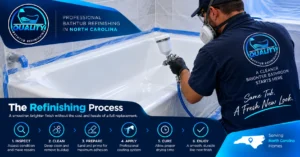
Professional refinishing follows a logical order. The exact products and timing vary by company and coating system, but the stages are consistent:
- Inspect and protect. Assess the tub for chips, cracks, and rust, then mask off surrounding walls, floors, and fixtures.
- Clean and degrease. Strip soap film, body oils, and mineral buildup. A contaminated surface is a leading reason coatings fail to bond.
- Repair. Fill and smooth chips and small cracks so the base is even.
- Abrade and prepare. Condition the surface, often by sanding or etching, so the coating has something to grip. This step decides most of the long-term result.
- Prime. Apply a bonding primer suited to the substrate.
- Coat. Apply the topcoat in controlled layers.
- Cure. Let the finish harden before use.
- Final check. Inspect the finished surface and clean up.
If there is one thing to take from this section, it is that preparation is where quality is won or lost. When refinished tubs peel or bubble, the cause is usually inadequate preparation, application error, or improper aftercare, not the tub. That is worth knowing before you compare quotes, because the cheapest bid is often cheap precisely because it shortcuts prep.
How Long Does Bathtub Refinishing Take?
Separate two different clocks, because confusing them is a common and costly mistake.
The first is the hands-on work, the preparation and application. For many bathtub refinishing jobs this is completed in about a day. The second is drying and curing, and curing is not the same as drying. A coating can feel dry to the touch long before it has cured enough to withstand water and use. Putting the tub back into service too early is one of the most common ways a good job goes bad.
Quality Bathtub Refinishing generally advises waiting about 24 to 48 hours after the coating cures before using the tub again. That said, exact curing and re-entry times depend on the specific coating system and the manufacturer’s instructions, so always follow the timing your refinisher gives you for the product they actually used.
How Long Does a Refinished Bathtub Last?
Be wary of any firm promise here, including specific year counts you may see online. Lifespan is a range that depends on many things, not a fixed number:
- The substrate and its condition
- The coating system used
- The quality of surface preparation
- Application quality
- How heavily the tub is used
- Cleaning products, especially abrasive ones
- Bath mats with suction cups, standing water, and caulk condition
- Whether the tub had previous coatings or repairs
- Ongoing maintenance
- The coating manufacturer’s specifications
A well-prepared finish on a sound tub, cleaned gently, can last for years. As a general expectation, a professionally refinished tub can last around 10 to 15 years with proper care, and Quality Bathtub Refinishing states that range for its own work. Treat that as a care-dependent estimate rather than a guarantee: a rushed job, or one scrubbed with harsh, gritty cleaners, can fail much sooner, while gentle maintenance helps a finish reach the upper end. When you compare durability claims between companies, it helps to know where the number comes from, because a coating manufacturer’s published specification, a contractor’s own warranty, and an anecdotal homeowner report carry three different weights.
Quality Bathtub Refinishing backs its work with a written warranty.
How Much Does Bathtub Refinishing Cost in North Carolina?
There is no single, reliable statewide North Carolina price, and this guide will not invent one. What refinishing costs depends on the specifics of your tub and the work it needs. The factors that move the price:
- Tub material and size
- Overall condition, and how much chip, crack, or rust repair is required
- Any previous coating that has to be dealt with first
- The amount of surface preparation the job needs
- The coating system and finish, including a custom color
- Labor and access
- Your local market
- How many surfaces you do at once, since combining a tub with a surround or sink can change the math
What refinishing reliably offers is a lower cost than a full replacement, because it avoids the new fixture, demolition, and plumbing work a replacement involves. For an honest number on your specific tub, an assessment beats any published average. A dedicated cost guide is planned as part of this site’s resource library; until it is live, the most accurate figure comes from requesting an estimate on your actual tub.
Bathtub Refinishing vs. Bathtub Replacement
Both are legitimate. The right call depends on the tub and your goals.
Refinishing tends to fit when the tub is structurally sound, the problems are on the surface, you are happy with the tub’s size and position, and you want to avoid demolition and its cost. It is also the sensible route for keeping an original tub in an older home, where a solid cast-iron tub is often worth preserving.
Replacement tends to fit when the tub is cracked through, rusted through, or structurally failing, when you want to change the tub’s size, shape, or location, or when you are already gutting the bathroom.
For perspective on how common tub work is, the 2025 U.S. Houzz Bathroom Trends Study, a survey of 1,737 U.S. homeowners, reported that 34% upgraded their bathtub during a renovation, 9% kept their existing tub, 26% removed it, and 25% had no tub. That is national data, not North Carolina-specific, but it shows that upgrading the tub you have is a mainstream choice rather than a niche one, and refinishing is one way to upgrade without removing.
DIY vs. Professional Bathtub Refinishing
Hardware stores sell refinishing kits, so it is fair to ask whether they work. The honest answer is that DIY and professional refinishing are not the same job at the same quality, and the gap shows up in three places: preparation, materials, and safety.
DIY kits can be cheaper, and for a very minor touch-up by a patient, careful person they can be adequate. The trade-offs are real, though. Results depend heavily on skill and on the quality of surface preparation, which is the hardest part to get right. The finish often does not last as long. And some stripping and coating products carry serious safety hazards that a homeowner is not equipped to control, which the next section explains. Homeowner discussions online return to the same two worries again and again, whether DIY kits actually hold up and why refinished tubs peel, which tells you those concerns are common rather than rare.
Professional work costs more and has to be scheduled, but it brings proper preparation, appropriate materials, and controlled application, which together decide whether the finish lasts. If you want that outcome without the risk, our professional bathtub refinishing team handles the preparation and coating for you.
Is Bathtub Refinishing Safe?
This deserves a straight answer, not reassurance. Refinishing can involve hazardous chemicals, and the risk has been serious enough to prompt federal action, so it is worth understanding rather than glossing over.
According to NIOSH, at least 14 workers died between 2000 and the agency’s reporting from using stripping agents that contained methylene chloride during bathtub refinishing. Methylene chloride is especially dangerous in small, enclosed bathrooms, and NIOSH is explicit that bathroom fans or open windows do not provide adequate ventilation for it. In April 2024, the U.S. Environmental Protection Agency (EPA) finalized a rule banning most uses of methylene chloride and adding stronger worker-protection requirements for the remaining industrial uses. OSHA also maintains a specific standard governing occupational methylene chloride exposure.
Two things this does not mean: it does not mean every refinishing job uses methylene chloride, and it does not mean all professional coating systems have the same chemical makeup. They do not. Products and methods vary.
What it does mean for you as a homeowner:
- Safety depends on the specific products, the application method, ventilation, protective equipment, and following the manufacturer’s and OSHA’s requirements. A vague “non-toxic” claim does not settle it.
- Be skeptical of anyone who tells you the process is “completely safe,” has “no fumes,” or that cracking a window is enough. Those statements do not match the federal guidance.
- The safest scenario is trained applicators using appropriate products and controls, with proper curing before the room goes back into use.
How to Care for a Refinished Bathtub
Aftercare is simple, and it has an outsized effect on how long the finish lasts.
- Use gentle, non-abrasive cleaners. Skip scouring powders, gritty pads, and harsh chemicals.
- Do not let soap, shampoo, or standing water sit on the surface. Rinse and dry the tub after use.
- Avoid dropping heavy or sharp objects, which can chip the coating.
- Be careful with suction-cup bath mats, which can mark or pull at a finish over time, and keep an eye on the caulk line so water does not sit against it.
These habits are the difference between a finish that ages gracefully and one that fails early. Detailed cleaning and maintenance guidance is planned as part of this site’s resource library.
How to Choose a Bathtub Refinishing Company
Because so much of the result depends on preparation and materials you cannot see once the job is done, choosing carefully matters more here than in many home projects. A practical checklist:
- Preparation. Ask how they prepare and bond the surface. This is where durability is decided.
- Repairs. Ask how they handle chips, cracks, and rust before coating.
- Coating system. Ask what system they use and what the manufacturer says about it.
- Experience with your tub material. Cast iron, fiberglass, and acrylic are not identical jobs.
- Safety procedures. Ask about products, ventilation, and protective equipment. A serious company answers clearly.
- Curing and re-entry. Ask how long before you can use the tub, and why.
- Warranty. Ask what is covered, for how long, and get it in writing.
- Previous work. Ask to see before-and-after examples.
- Written estimate. Get the scope and price in writing.
- Service area. Confirm they actually serve your location.
Asking these is not being difficult. A refinisher who prepares surfaces properly and stands behind the work will welcome the questions. One practical tip for a faster, more accurate quote: take a few clear photos of the tub, including any chips, cracks, rust, or previously refinished spots, and note the material if you know it. Good photos let a refinisher tell you sooner whether refinishing is the right call and roughly what the job involves.
Measured against that checklist, Quality Bathtub Refinishing brings more than five years of experience, offers free online estimates so you can start with photos rather than a scheduled visit, and backs its work with a written warranty. Its current Google rating is 5.0 stars across 82 reviews. Those are the kinds of concrete, verifiable details worth confirming with any refinisher you consider, not just taking on trust.
Bathtub Refinishing in North Carolina: What Homeowners Should Consider
North Carolina has a deep stock of older housing, and older homes are where you most often find tubs worth restoring rather than replacing. Greensboro is a useful illustration: the City’s 2025 Analysis of Impediments to Fair Housing Choice, drawing on U.S. Census American Community Survey estimates, reported roughly 133,029 housing units in 2022, with about 43.8% built in 1979 or earlier and about 19.6% built in 1959 or earlier. That is local Greensboro data, not a statewide figure, but it reflects a pattern across many established North Carolina communities: plenty of homes old enough to have original tubs.
Those original tubs, cast iron in particular, are often structurally sound long after their surfaces wear out, which is exactly the situation refinishing suits. Restoring a usable fixture also avoids some of the material waste that comes with tearing one out; the EPA notes that reducing and reusing construction and demolition materials is a meaningful way to cut waste, though refinishing is not waste-free and this guide will not claim otherwise.
Service availability does vary by location. If you want to confirm coverage for your area, our service areas page lists the communities we cover across the region, including hubs like Greensboro and High Point. If you do not see your town, it is worth asking directly.
Frequently Asked Questions
Is bathtub refinishing worth it?
For a structurally sound tub with surface problems, it usually is, because it restores the tub for a fraction of replacement cost and without demolition. It is not worth it for a tub that is cracked through, rusted through, or structurally failing, where replacement is the more honest choice.
How long does bathtub refinishing take?
The hands-on work is often done in a single visit, but the coating then needs time to cure before use. Cure and re-entry times depend on the coating system, so follow the specific timing your refinisher provides rather than a general rule.
How long does a refinished bathtub last?
It depends on the substrate, coating, preparation, use, and cleaning, so there is no single guaranteed number. A well-prepared finish cared for with gentle cleaners can last for years; a rushed job or harsh cleaning shortens it considerably.
Can an old cast-iron tub be refinished?
Cast iron is one of the best candidates. These tubs are heavy and durable and often outlast their surfaces, so refinishing a sound cast-iron tub can bring it back to a smooth, glossy finish without replacing a fixture that is otherwise fine.
Can a fiberglass tub be refinished?
Yes, the surface can be refinished. Fiberglass has its own quirks, though: a floor that flexes or a stress crack is a structural issue that needs repair first, before any coating.
Can a chipped bathtub be refinished?
Usually. Chips are repaired as part of surface preparation, before the coating is applied. Damage that runs deeper than the surface, like a crack that flexes or rust through the material, is a different problem that may need repair or replacement first.
Is bathtub refinishing safe?
It can be done safely by trained applicators using appropriate products, ventilation, and protective equipment. It can also be dangerous when hazardous stripping chemicals are misused. Federal agencies have documented serious risks tied to methylene chloride specifically, so proper products and controls matter. Be skeptical of “completely safe” or “fume-free” claims.
How soon can you use the bathtub after refinishing?
After the coating has cured, which is not the same as dry to the touch. The exact wait depends on the coating system, so follow your refinisher’s product-specific instructions.
Is refinishing cheaper than replacing a bathtub?
Generally yes, because it avoids the new fixture, demolition, and plumbing work involved in replacement. The exact price depends on your tub’s material, size, and condition.