
What Is a Bathtub Refinishing Warranty?
A warranty is a promise about the work or the product, and its real meaning is set by its written terms. In refinishing, a warranty usually addresses the coating and the workmanship: whether the new finish will hold up, and what the company will do if it does not, within a defined period and under defined conditions.
Federal warranty law is a useful frame here. Under the Magnuson-Moss Warranty Act, which the Federal Trade Commission administers, a written warranty on a consumer product must make its terms clear and available, and warranties are commonly labeled as either “full” or “limited.” Most refinishing warranties you encounter will be limited warranties, meaning they cover specific things under specific conditions rather than promising to fix anything that goes wrong. That is normal. What matters is reading which things, and which conditions.
A warranty is also not the same as a guarantee of a perfect result forever. It is a defined commitment with a start, an end, and a set of exclusions. Understanding those three parts is most of the work.
How Bathtub Refinishing Warranties Usually Work
Warranty terms vary by contractor and coating system, so treat the points below as the structure to look for rather than a fixed standard.
Warranty Length
Length is the duration the stated coverage remains in effect. It is the easiest thing to advertise and the easiest to misread. A longer warranty does not automatically mean broader coverage, and it does not mean the surface is guaranteed to look new for that entire period under every condition. A five-year warranty that covers peeling and adhesion failure can be more valuable than a longer one that excludes most common problems. Read length together with coverage, never on its own.
What the Warranty Covers
Coverage is the list of defects or failures the company will address. In refinishing, this often centers on the finish itself: things like the coating peeling, losing adhesion, or failing earlier than it should. Whether a specific problem is covered depends on the written terms and on the cause of the failure, which is why the coverage and exclusions sections have to be read side by side.
What the Warranty Excludes
Exclusions are the situations where the company does not accept responsibility. Every limited warranty has them, and they often matter more than the coverage list, because they define the real edges of the promise. Common exclusion categories are discussed further below. The point to hold onto is that a warranty’s practical value is coverage minus exclusions, not coverage alone.
Who Provides the Warranty?
There can be more than one warranty in play. A workmanship warranty comes from the contractor and covers their application and labor. A product or manufacturer warranty, where one exists, comes from the maker of the coating system and covers the material itself. Not every job involves both, and you should not assume it does. Ask who is actually standing behind the work, because if a coating fails, it matters whether your recourse is with the contractor, the manufacturer, or both, and how a claim would be handled in each case.
What Should a Bathtub Refinishing Warranty Cover?
Rather than assume a fixed list is covered, use this as a set of items to get clarified in writing. Whether each is covered depends on the specific warranty.
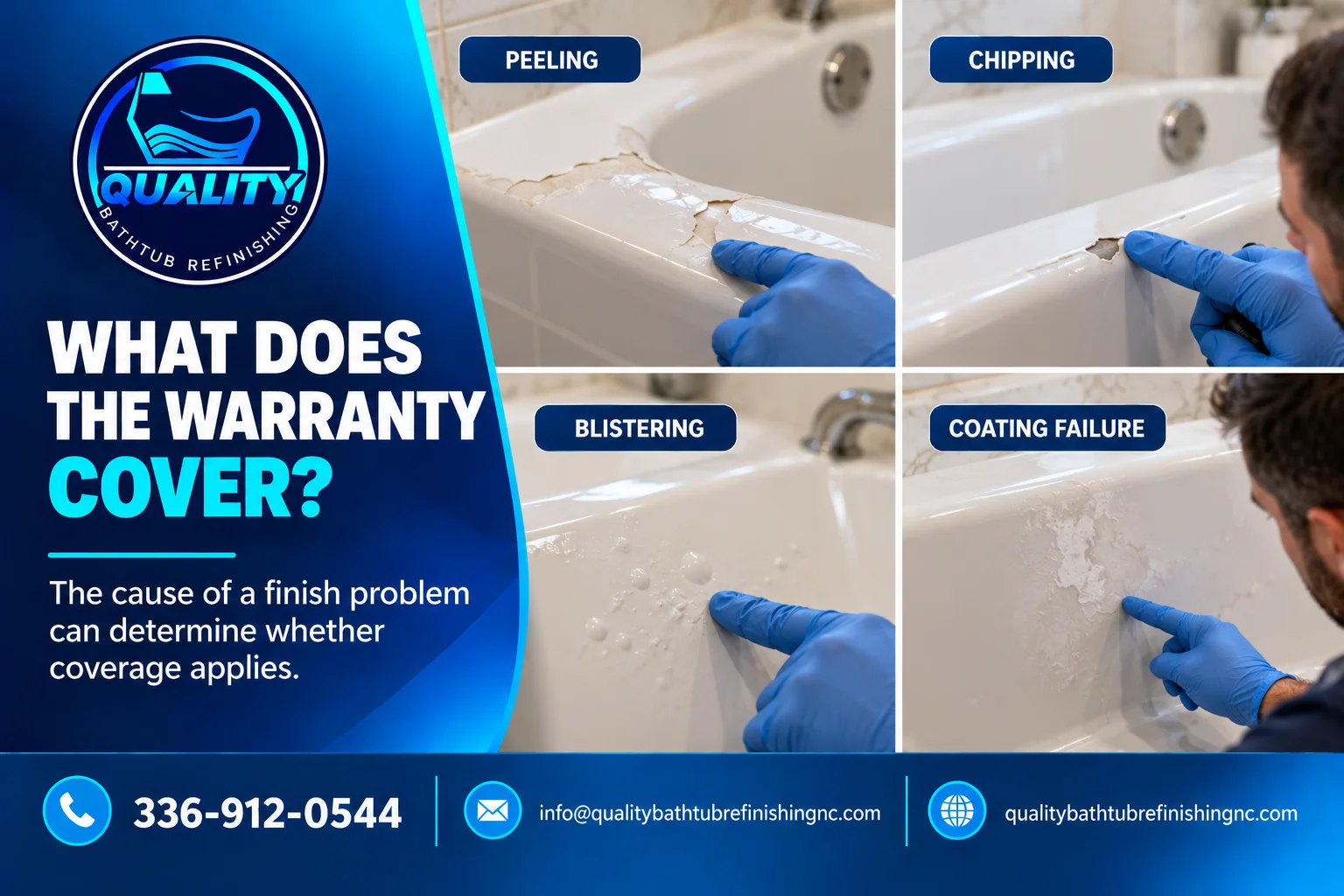
Areas homeowners commonly want defined include peeling or delamination of the finish, premature coating failure, adhesion failure, abnormal bubbling or blistering, chipping of the new finish, and general surface defects in the coating. For each one, the useful question is not “is this covered?” in the abstract, but “is this covered under this written warranty, and under what conditions?”
It also helps to understand that a finish failure can involve more than one factor. Surface preparation, the condition of the substrate underneath, how the coating was applied, how it cured, ongoing moisture, impact, the cleaning products used, and general maintenance can all play a part, sometimes together. Because failures can have mixed causes, warranties tend to tie coverage to cause. That is why the same symptom, say a patch of peeling, might be covered in one situation and excluded in another.
Common Bathtub Refinishing Warranty Exclusions
The categories below are examples of exclusions that may appear in refinishing warranties. They are not necessarily any specific company’s exclusions, and you should ask which of them apply to the warranty in front of you. Useful framing when you ask: “Does this warranty exclude…”
- Impact damage, such as a dropped object chipping the finish
- Abuse or misuse of the surface
- Abrasive cleaning, such as scouring pads or gritty cleansers
- Unsuitable chemicals or cleaners
- Failure to follow the company’s care instructions
- Structural movement of the tub or the surrounding structure
- Pre-existing substrate problems that were present before refinishing
- Leaks or plumbing problems affecting the surface
- Damage to areas outside the refinished surface
- Unauthorized repairs or modifications by others
- Normal wear, where the warranty specifies it
An exclusion list is not a warning sign by itself. Every limited warranty has one. What you are checking is whether the exclusions are reasonable and clearly stated, and whether they quietly remove most of what you thought you were getting.
Does a Warranty Cover Peeling, Chipping, or Coating Failure?
These are the failures homeowners ask about most, so it is worth taking them one at a time. In every case, coverage depends on the written terms and on the cause.
Peeling or Delamination
Peeling or delamination is the finish separating from the surface underneath. When it happens early and broadly, it is often discussed in terms of adhesion, which can relate to preparation, the coating, application, or curing. Many workmanship warranties are written with this kind of failure in mind, but whether a given instance is covered still depends on the terms and on whether an excluded cause (such as abrasive cleaning) is involved.
Chipping
Chipping is a localized loss of the finish. Here the cause matters a great deal. Chipping that reflects a coating or adhesion problem is a different question from chipping caused by dropping something heavy in the tub, which many warranties would treat as impact damage and exclude. Ask specifically how the warranty distinguishes the two.
Blistering or Bubbling
Blistering or bubbling is a raised or disrupted area in the finish. Like peeling, it can involve preparation, application, curing, or moisture. Whether it is covered depends on the written terms and on the determined cause, which is one reason some warranties call for an inspection before a claim is resolved.
Premature Coating Failure
Premature failure is the finish not lasting as long as it reasonably should. This is often the core of what a workmanship warranty is meant to address, but “premature” is defined by the warranty, not by expectation alone, and any applicable exclusions still apply. This is also where the distinction between warranty period and expected lifespan, discussed below, becomes important.

Does a Bathtub Refinishing Warranty Cover Repairs?
“Repair” can mean several different things in a warranty conversation, and they are worth separating:
- Repairing existing damage before refinishing. Fixing chips, cracks, or rust as part of preparing the tub is part of the scope of work, not usually a warranty item. Confirm what repairs the estimate includes.
- Warranty repair after refinishing. If a covered problem appears within the warranty period, ask whether the company repairs the affected area or refinishes the whole surface, and whether labor and materials are both included.
- Structural damage. Movement or structural problems in the tub or its support are commonly excluded, since they are outside the coating itself.
- Damage caused after completion. Impact, misuse, or unsuitable cleaning after the job is typically excluded rather than treated as a warranty repair.
The practical questions are what triggers a warranty repair, what form that repair takes, and who pays for the labor. A warranty that “covers peeling” but leaves you paying labor is a different promise from one that does not.
What About the Tub’s Existing Condition?
The condition of the tub before refinishing affects both the result and, often, the warranty. A surface with deep damage, active rust, structural cracks, or a previous coating that is failing is a different starting point from one with ordinary wear. Warranties frequently exclude problems that trace back to pre-existing substrate conditions, because those are not something the new finish created.
This is why a company that assesses the tub’s material and condition before quoting is giving you a more realistic picture, and why it is fair to ask how pre-existing conditions are handled in the warranty. If you are not sure whether your tub is a good candidate in the first place, our guide on how to know if a bathtub can be refinished covers the factors involved, and bathtub repair vs refinishing explains when damage is repaired versus when it changes the plan.
Warranty vs. Expected Lifespan
This distinction matters more than almost anything else in a warranty conversation, and it is easy to blur.
Warranty duration is not the same as expected lifespan. The warranty is the period during which the company will address covered defects under defined conditions. The expected lifespan is roughly how long the finish may last in normal use with proper care. Quality Bathtub Refinishing NC, like many companies, describes a potential lifespan in the range of about 10 to 15 years with proper care. That is a general expectation, not a guarantee, and it is not the same thing as the warranty period.
The two can differ in both directions. A refinished tub may have an expected useful life that is longer than the formal warranty. And a long warranty does not mean the surface will stay perfect for that entire time under every condition, because coverage still depends on cause and on the exclusions. Do not assume the warranty covers the whole expected lifespan, and do not read a lifespan estimate as a promise. Treat them as two separate pieces of information.
Warranty vs. Aftercare and Maintenance
A warranty and your aftercare are connected, because many warranties tie coverage to following the company’s care instructions. If a warranty requires specific maintenance and you use an abrasive cleaner it warns against, a later problem may fall under an exclusion.
So it is worth understanding, before you commit, when the tub can be used again, which cleaning practices are recommended, which products may be unsuitable, and what maintenance the warranty expects. This guide is not the place for the full routine. Our aftercare and curing guide covers cure timing and first use, and our maintenance guide covers ongoing cleaning and care. The warranty point is simply that following that guidance is often part of keeping coverage valid.
Warranty and Choosing a Company
Warranty questions naturally come up while you are choosing a company, and they belong in that process. But the warranty itself deserves separate attention, because the length of coverage and the actual terms can differ substantially between companies, and the details are easy to skip past during a sales conversation.
If you are still at the stage of comparing companies, our guide on how to choose a bathtub refinishing company covers the full set of evaluation criteria, and its questions to ask checklist includes the hiring basics. This guide goes deeper on the warranty specifically, so use them together rather than expecting either one to cover everything.
What Should Be Included in a Written Warranty?
Use this as a checklist of items to look for or ask about. Not every warranty is legally required to contain every item, and formats vary, but a warranty that spells these out is much easier to rely on than one that leaves them vague.
- Warranty duration
- The specific defects or failures covered
- The exclusions
- Whether labor is included in a warranty repair
- Whether materials are included
- The claim procedure, including who to contact
- Whether an inspection is required before a claim is resolved
- Whether the remedy is a spot repair or full refinishing
- Any maintenance requirements tied to coverage
- Any care requirements, such as products to avoid
- Whether the warranty is transferable, if that matters to you
- Contact information for making a claim
Getting these in writing before work starts is the single most useful thing you can do, because a verbal assurance is hard to hold anyone to once a problem appears.

10 Questions to Ask About a Bathtub Refinishing Warranty
These are warranty-specific questions, distinct from general hiring questions. Bring them to the estimate conversation.
- How long is the warranty, and when does it start?
- Exactly what defects or failures does it cover?
- What does it exclude?
- Does it cover peeling, adhesion failure, and premature coating failure?
- How does it treat chipping, and does that depend on the cause?
- If a covered problem appears, do you repair the area or refinish the whole tub?
- Are labor and materials both included in a warranty repair?
- Is an inspection required before a claim is approved?
- Are there maintenance or cleaning requirements I must follow to keep the warranty valid?
- Is the warranty transferable if I sell the home, and is it provided in writing?
What Can Void or Limit a Bathtub Refinishing Warranty?
The categories below are the kinds of things that commonly void or limit refinishing warranties. Whether they apply depends on the specific written terms, so treat these as areas to clarify, not as universal rules.
- Using abrasive pads or cleansers the warranty warns against
- Using chemicals or cleaners the company lists as unsuitable
- Not following the stated care instructions
- Impact damage from dropped objects or heavy use
- Allowing others to make unauthorized repairs or modifications
- Structural movement or pre-existing substrate problems
- Plumbing leaks or moisture intrusion affecting the surface
A single item on this list does not mean a company is being unreasonable; most of these are standard exclusions. What you want is to know them in advance so you can keep the coverage intact.
How to Read a Bathtub Refinishing Warranty Before You Hire
A simple process:
- Get it in writing before the work is scheduled. If you cannot see the terms until after, that itself is worth questioning.
- Read the exclusions first. They define the real limits of the coverage more than the headline number does.
- Match coverage to the failures you actually worry about, such as peeling or premature failure, and confirm those are addressed.
- Check the remedy and who pays. Spot repair or full refinishing, and whether labor is included.
- Note the maintenance requirements so you know what keeps the warranty valid.
- Confirm who provides it, the contractor, the coating manufacturer, or both, and how a claim works for each.
Reading a warranty this way takes a few minutes and tells you far more than the advertised length.
Bathtub Refinishing Warranty at Quality Bathtub Refinishing NC
Quality Bathtub Refinishing NC states that it provides a written warranty with its bathtub refinishing work, and it offers free estimates. The company describes bathtub refinishing as a restoration approach for suitable surfaces and works with materials including porcelain, cast iron, clawfoot, and fiberglass-related tubs. It describes a typical project as roughly one day, with a general guideline of about 24 to 48 hours before normal use depending on curing, and a potential lifespan in the range of about 10 to 15 years with proper care. These figures are the company’s stated expectations rather than guarantees.
The website confirms that a written warranty is provided, but it does not clearly publish the exact warranty duration, the specific coverage, or the detailed exclusions. Rather than guess at those, the honest position is that a homeowner should request the written warranty terms directly and read them using the checklist above. The specific duration, what is covered, what is excluded, the claim process, and whether coverage is transferable are best confirmed with the company in writing (see the client input section below). You can start with the bathtub refinishing services page to see what is offered.
Frequently Asked Questions
How long should a bathtub refinishing warranty last?
There is no single industry standard length, and warranty terms vary by contractor and coating system. A longer warranty is not automatically better, because coverage and exclusions matter more than the number. Read the length together with what is covered and what is excluded rather than choosing on duration alone.
Does a bathtub refinishing warranty cover peeling?
Many workmanship warranties are written with peeling and adhesion failure in mind, but whether a specific instance is covered depends on the written terms and the cause. Peeling linked to a coating or application issue is treated differently from peeling that follows an excluded cause such as abrasive cleaning. Ask how the warranty addresses peeling specifically.
Does a warranty cover chips in a refinished bathtub?
It depends on the cause and the terms. Chipping tied to a coating or adhesion problem is a different question from chipping caused by dropping something heavy, which many warranties exclude as impact damage. Ask the company how the warranty distinguishes the two.
Does a bathtub refinishing warranty cover cracks?
Cracking that reflects structural movement or a pre-existing substrate problem is commonly excluded, because it is outside the coating itself. Whether any cracking is covered depends entirely on the written terms, so ask directly.
Does a warranty cover damage caused by cleaning products?
Usually not. Damage from abrasive pads or unsuitable chemicals is a common exclusion, and using products the warranty warns against can also void coverage. This is why the care instructions and the warranty should be read together.
Is a refinishing warranty the same as a product warranty?
Not necessarily. A workmanship warranty comes from the contractor and covers their application and labor. A product or manufacturer warranty, where one exists, comes from the coating maker and covers the material. Not every job includes both, so ask who is actually providing the warranty.
Does a bathtub warranty cover the entire tub?
A refinishing warranty generally concerns the refinished surface and the workmanship, not necessarily every part of the tub or the surrounding bathroom. Items such as caulk, drains, plumbing fixtures, and hardware may fall outside coating warranty coverage. Confirm exactly what surface and components the warranty applies to.
What should I ask before signing a refinishing estimate?
At minimum, get the warranty in writing and confirm its duration, coverage, exclusions, whether labor and materials are included in a repair, the claim procedure, any maintenance requirements, and who provides the warranty. The written warranty checklist above lists the full set.
Does a longer warranty mean better workmanship?
Not by itself. Duration is a marketing number until you read the terms. A shorter warranty with clear coverage of the failures you care about can be more valuable than a longer one full of exclusions. Judge the terms, not the length.
How can I make sure I understand my warranty?
Get it in writing before work starts, read the exclusions first, match the coverage to the problems you actually worry about, check the remedy and who pays for labor, note the maintenance requirements, and confirm who provides the warranty and how a claim works. If anything is unclear, ask for it to be clarified in writing.