

Can a Fiberglass Shower Be Repaired?
Many fiberglass shower problems can be repaired, but not all, and repairability depends on the damage and the condition underneath. Small surface cracks, chips, and holes in a fiberglass unit can often be addressed by a professional, while damage tied to structural weakness, inadequate support beneath the base, movement, or an active leak is a different matter. In those cases a patch on the surface does not solve the real problem.
The honest framing is that the question is not just “is it cracked?” but “why is it cracked, and is the structure sound?” A hairline crack in an otherwise solid, well-supported shower is a very different situation from a crack in a floor that flexes underfoot, even though both look like cracks. Because the cause often sits out of sight, a reliable answer usually requires a professional assessment rather than a judgment from a photo. Repair is frequently possible; whether it is the right answer for your shower depends on what an inspection finds. For how surface restoration fits into the picture, see our shower refinishing guide.
Common Types of Fiberglass Shower Damage

Fiberglass showers show a handful of recognizable problems, and telling them apart matters because they do not all mean the same thing.
Hairline and surface cracks. Fine cracks in the top finish (the gelcoat) are common with age and use. Many are cosmetic, but some fine cracks can be early signs of stress, so they are worth having looked at rather than assumed harmless.
Larger cracks. A crack you can feel, that is spreading, or that sits in a high-stress area such as the floor deserves prompt attention, since it may involve more than the surface layer.
Holes and chips. Impact or a dropped object can chip or puncture the surface. A chip is usually localized; a hole that goes through the material is more involved and raises the question of what is behind it.
Soft spots or a flexing floor. A shower floor that gives, flexes, or feels spongy is one of the more serious signs, because it often points to a problem with the support beneath the base rather than the surface itself. This one gets its own section below.
Damage around drains, corners, seams, and edges. These transition points take stress and see a lot of water, so cracks or deterioration here can be more consequential than the same mark on a flat wall.
Surface wear and discoloration. Dullness, staining, and a worn finish are cosmetic conditions rather than damage, and they are the classic case for refinishing rather than repair.
Use subheadings like these to locate your situation, but treat them as a starting point. Two showers with the same visible crack can need different responses depending on what is underneath.
What Causes Fiberglass Showers to Crack?
Fiberglass shower cracks have several possible causes, and the cause matters more than the crack itself. Commonly discussed contributors include inadequate support beneath the shower floor or base (so the material flexes under weight), movement or settling in the surrounding structure, impact from a heavy object, the natural aging and brittleness of the gelcoat finish over years of use, and stresses introduced during manufacture or installation.
The important caution is that these are possibilities, not a diagnosis. It is not responsible to look at a crack, or a photo of one, and declare the cause, because several of these factors are invisible from the surface and some can occur together. Inadequate support, in particular, is a structural issue that a surface repair will not cure; the crack will tend to return if the floor keeps flexing. That is why a professional assessment that considers the support and the surrounding structure, not just the visible crack, is the reliable way to understand why your shower cracked, and therefore what will actually fix it.
How Fiberglass Shower Repair Works
Professional fiberglass shower repair generally starts with assessment and then matches the method to the damage, so there is no single process that fits every case. A contractor typically examines the damage, considers the likely cause and whether the structure and support are sound, and only then recommends an approach. What follows depends on what they find.
For cosmetic surface damage on a sound shower, the work focuses on the finish. For a crack or hole that involves more than the top layer, repair may involve patching and reinforcing the fiberglass so the repaired area has appropriate strength, which is more involved than a surface touch-up. Where the real issue is inadequate support or movement beneath the base, the underlying problem has to be addressed, not just the surface, or the damage is likely to recur. These are different levels of work, and it is a mistake to treat a quick surface patch as equivalent to a structural repair.
This guide deliberately does not give step-by-step instructions for major structural fiberglass repair. Done incorrectly, that kind of work can hide a problem rather than solve it, or create a repair that fails and lets water reach the structure. The responsible path for anything beyond minor cosmetic damage is a professional who can assess the cause and carry out the right level of repair. For the surface side of that work, our shower refinishing service addresses finish restoration on suitable showers.
What Does a Soft Spot in a Fiberglass Shower Floor Mean?
A soft spot or a flexing shower floor usually signals a problem with the support beneath the base, and it should not be ignored. Fiberglass floors are meant to feel firm; when one gives or feels spongy, it often means the material is no longer fully supported underneath, whether because the original support was inadequate, something beneath has deteriorated, or moisture has affected the structure below. The flex itself can then cause or worsen cracks, which is how a support problem and a surface crack end up appearing together.
What a soft spot does not automatically mean is that the shower must be replaced. The appropriate response depends on why the floor is flexing and how far any underlying problem has gone, and that is genuinely not something to judge from the surface. Because a soft floor can be associated with hidden moisture or structural issues, it is one of the clearer cases for a prompt professional inspection rather than a wait-and-see approach or a surface coating. An inspection determines whether the support can be corrected and the shower repaired, or whether replacement is the sounder choice.
Can You Refinish a Cracked Fiberglass Shower Instead of Repairing It?
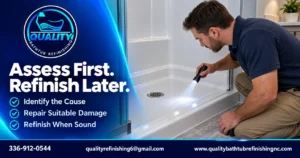
Refinishing and crack repair are not the same thing, and refinishing alone does not fix a structural crack. Refinishing restores the surface of a sound shower, it renews the finish, color, and appearance. Crack repair, reinforcement, and correction of inadequate support address the structure and cause. Applying a new surface coating over an unrepaired structural crack or a flexing floor does not make the underlying problem go away; at best it hides it for a time, and the crack can reappear as the real issue continues.
Refinishing becomes relevant once any structural or cause-related problem has been properly addressed and the shower is sound, at that point renewing the surface can make sense. The order matters: assess and repair the real problem first, refinish second if appropriate. Refinishing is a strong option for cosmetic wear and dull, dated surfaces on a solid shower; it is not a shortcut around a crack with a structural cause. For the full comparison of restoring a surface versus replacing the shower, see our shower refinishing vs. replacement guide, and for care of a refinished surface, our bathtub refinishing maintenance guide covers the principles.
Fiberglass Shower Repair vs. Replacement
Repair tends to make sense for contained, repairable damage on a fundamentally sound shower; replacement comes into play when the damage is extensive, the structure or support is compromised, or there is an unresolved leak. A short way to think about the decision:
- Lean toward repair when the damage is localized, the structure and support are sound, there is no active leak, and the cause can be addressed.
- Lean toward replacement when there is widespread or recurring cracking, significant soft or failing support, serious water damage, a persistent leak that cannot be reliably resolved, or when repair costs approach the cost of replacing the unit.
This is a framework, not a verdict, because the deciding facts, especially the condition of the support and whether moisture has reached the structure, often need an inspection to establish. Cost is part of the decision too: when a repair would be extensive and uncertain, replacement can be the better value even though it is a larger project. For the broader decision between restoring and replacing a shower, including cost, results, time, and disruption, see our shower refinishing vs. replacement guide.
How Much Does Fiberglass Shower Repair Cost?
Fiberglass shower repair cost varies with the damage and the work required, so the useful thing to understand is the drivers rather than a single number. There is no reliable one-size figure, and this guide does not invent a local average or present the price of a small cosmetic patch as if it were the cost of a structural repair. The main factors include:
- The size and type of damage (a small chip versus a large crack or a hole).
- Whether the repair is cosmetic or requires reinforcement.
- Whether the underlying cause (such as inadequate support) must be corrected.
- Accessibility of the damaged area.
- The material and its compatibility with repair products.
- Labor involved.
A cosmetic surface repair and a structural repair that involves correcting the support are different jobs at different price levels, and lumping them together is how misleading estimates happen. The reliable way to know your cost is a written estimate based on an actual assessment of your shower, with the scope spelled out. For context on what drives surface refinishing cost specifically, see our bathtub refinishing cost guide, keeping in mind that a repair with structural work is a different scope.
How Long Does a Fiberglass Shower Repair Last?
How long a fiberglass shower repair lasts depends on the repair itself and, crucially, on whether the original cause was corrected. A repair that addresses only the surface while leaving a flexing floor or inadequate support in place tends not to last, because the stress that caused the damage is still at work. A repair that corrects the underlying cause, uses compatible materials, and is properly carried out has a much better chance of holding up. Other factors include the quality of the installation and support, product compatibility, and how the shower is maintained afterward.
This guide does not attach a fixed number of years to a repair, because longevity genuinely rests on those conditions rather than on a borrowed figure, and it does not transfer any bathtub repair or refinishing lifespan to shower repair. The most honest guidance is that a well-done repair of a correctly diagnosed problem, followed by gentle care, is what gives longevity, while a surface fix over an uncorrected structural cause is the common reason repairs fail early. Ask any contractor what cause they identified and what their repair warranty covers.
Signs You Should Get Your Shower Inspected
Some signs point to getting a professional look sooner rather than later. Have the shower inspected if you notice:
- A crack that is widening, spreading, or recurring after a previous repair.
- A floor that flexes, gives, or feels soft underfoot.
- Water appearing outside the shower, or persistent dampness.
- Soft or discolored flooring, walls, or ceiling near or below the shower.
- Visible deterioration around the drain, corners, seams, or base.
- Any damage you are unsure about that involves more than the surface finish.
Several of these, especially a soft floor or signs of moisture outside the shower, can indicate a problem beyond the surface, and those are not reliably judged from a photo or a quick glance. A crack by itself does not prove a leak, but damage near the base, drain, or wall transitions is worth prompt assessment rather than a wait. Catching an underlying problem early generally keeps the options, and the cost, more manageable.
How to Choose a Fiberglass Shower Repair Professional
Choosing well comes down to asking the right questions, because the biggest risk is a surface fix for a structural problem. Good questions to ask a prospective contractor:
- Do you assess the cause of the damage, including the support beneath the floor, not just the visible crack?
- Is this damage repairable, and why or why not?
- Is the repair cosmetic, or does it involve reinforcement or correcting the support?
- What products or systems do you use, and are they compatible with my shower’s material?
- Will you provide a written estimate with the scope clearly stated?
- What warranty applies, and what does it cover?
- What are the limits of the repair, and when would you recommend replacement instead?
A contractor who distinguishes cosmetic from structural work and is willing to say when repair is not the right answer is more trustworthy than one who promises every crack is an easy fix. For a fuller set of vetting principles that apply to this kind of work, see our how to choose a bathtub refinishing company guide. If your shower’s issue is cosmetic surface wear on a sound unit, the company’s shower refinishing service is the relevant option; for anything structural, start with an assessment.
Frequently Asked Questions
Can a cracked fiberglass shower base be repaired?
Sometimes, depending on the crack and the support beneath the base. A crack in a well-supported base may be repairable, while a crack over a flexing or inadequate support usually needs the underlying support addressed, not just a surface patch, or it tends to return. Because the support is out of sight, a professional assessment is the reliable way to know whether repair will hold.
Can a hole in a fiberglass shower be patched?
Often a hole in fiberglass can be patched and reinforced by a professional, but it is more involved than fixing a surface chip, and what sits behind the hole matters. A hole that has let water reach the structure raises additional concerns. An assessment determines whether a patch is appropriate on its own or whether other damage needs attention first.
Is a soft spot in a shower floor serious?
A soft or flexing floor is one of the more serious signs, because it usually points to a problem with the support beneath the base rather than just the surface. It should not be ignored, and it is a clear case for a prompt inspection. It does not automatically mean replacement, but it does mean the cause needs to be understood before deciding on a repair.
Can fiberglass shower cracks come back after repair?
Yes, if the underlying cause was not corrected. A surface repair over a flexing floor or inadequate support tends to crack again because the stress is still present. A repair that addresses the actual cause has a much better chance of lasting. This is why diagnosing the cause, not just filling the crack, is the key to a durable repair.
Is fiberglass shower repair different from refinishing?
Yes. Refinishing restores the surface and appearance of a sound shower, while repair addresses cracks, holes, and structural or support problems. Refinishing does not fix a structural crack or a flexing floor; applying a coating over an unrepaired structural issue hides it rather than solving it. Any structural problem should be repaired first, with refinishing considered afterward if appropriate.
When should a damaged fiberglass shower be replaced?
Replacement tends to make sense when cracking is widespread or recurring, the support is significantly compromised, there is serious water damage, or a persistent leak cannot be reliably resolved, as well as when repair would cost close to replacement. Several of these depend on what an inspection finds beneath the surface, so a professional assessment is the reliable basis for the decision.
Can a leaking shower base be fixed with a surface coating?
No. A surface coating or caulk does not fix a leak coming from the base, drain, or structure, because the problem originates below or behind the surface. The leak needs to be diagnosed and properly resolved first. Coating over an active leak hides it temporarily while water may continue reaching the structure, which makes the eventual problem worse.
Conclusion
The sound way to handle a damaged fiberglass shower is to work in order: identify the type of damage, investigate whether there is a problem beneath the surface, and then choose a repair or replacement approach that matches the actual condition. Cosmetic wear on a solid shower is a candidate for surface restoration; a crack with a structural cause, a soft floor, or a leak needs the underlying issue addressed, not covered over. Because so much of what decides the right path sits out of sight, a professional assessment is the reliable next step for anything beyond minor surface damage. If your shower’s problem is cosmetic and the unit is sound, you can start with an assessment through the company’s shower refinishing service; if the trouble runs deeper, an inspection will point you toward the right repair or toward replacement.