
What are the signs a bathtub may need refinishing?
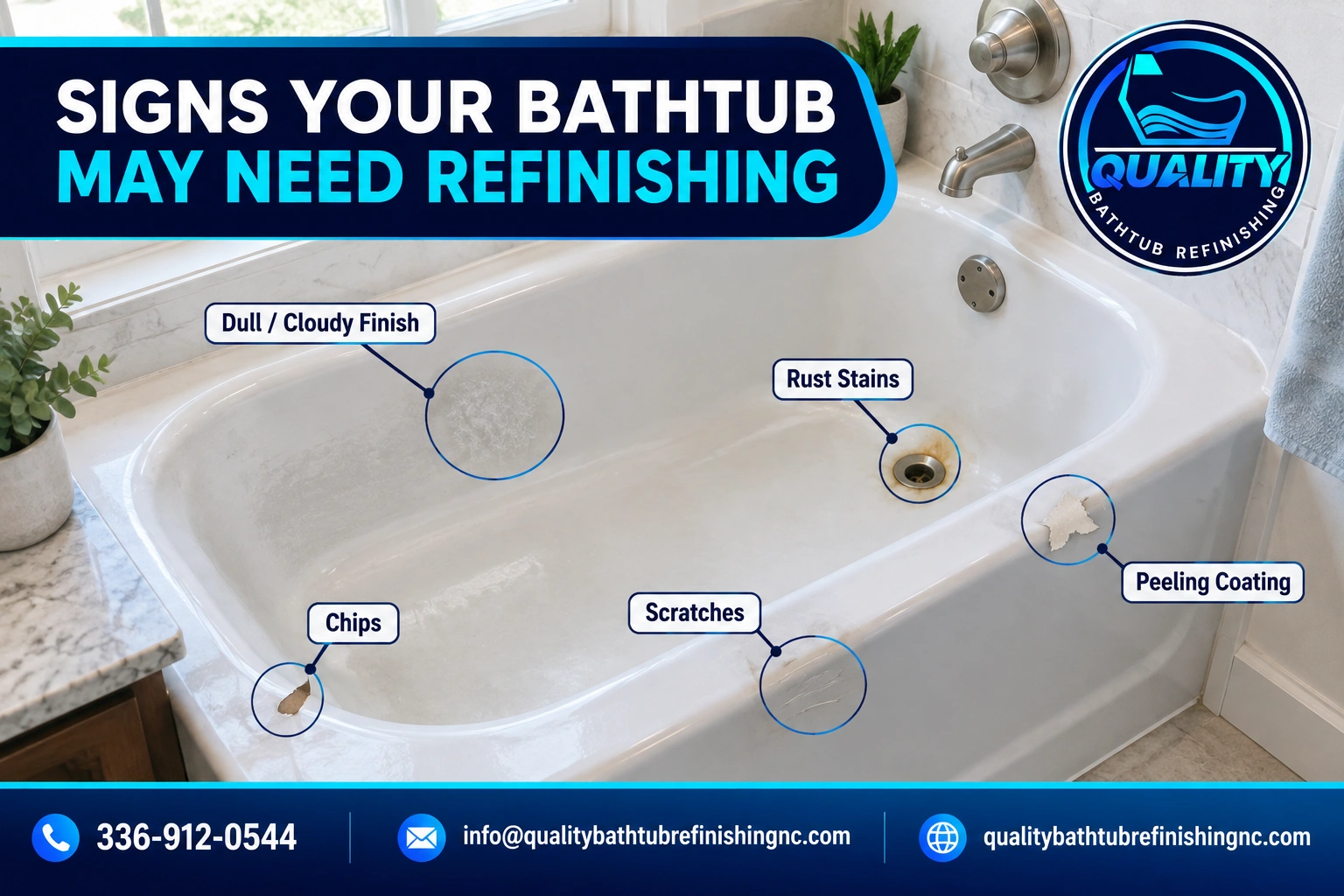
This is a look-and-identify guide. You have noticed something on your tub, a dull patch, a stain that will not scrub out, a chip, a spot of rust, and you want to know what it means before you call anyone. The short version: the most common visible signs are a dull or worn finish, persistent stains or discoloration, scratches, small chips, an outdated color, a surface that will not stay clean, general wear, surface rust, and a previously refinished coating that is peeling. Most of these are surface problems, and surface problems are what refinishing is built to address on a sound tub.
The important caveat runs through the whole guide: a visible sign tells you something is there, not what to do about it. The same-looking mark can be a purely cosmetic issue on one tub and a symptom of something deeper on another. Material, severity, the condition of the surface underneath, and whether the tub was coated before all change the answer. So this guide helps you read the signs and understand what each one may indicate. It does not diagnose your specific tub, and it deliberately stops short of telling you to refinish.
If what you actually want is to decide whether the timing and the money make sense once you have identified a problem, that is a different question, and our guide on when to refinish a bathtub walks through that decision. This page is narrower: it is about recognizing what you are looking at.
Sign 1: The finish looks dull or worn
What you may see: The surface has lost its gloss. It looks flat, cloudy, or tired even right after cleaning, and it may feel slightly rough where it used to be smooth.
What it may indicate: Years of use and cleaning gradually wear down the original finish. A dull, worn look is one of the most common cosmetic reasons homeowners look into refinishing, and on a structurally sound tub it points squarely at the surface.
Refinishing angle: This is close to the textbook case for refinishing, because the problem is the finish itself. The main thing that changes the answer is how far the wear has gone and whether the tub underneath is sound.
When to have it looked at: If the “dull” areas are actually rough, pitted, or thin enough that the material beneath seems exposed, that is worth a professional look rather than assuming it is only surface dullness.
Sign 2: Persistent stains and discoloration
What you may see: Marks, yellowing, or a grayed cast that no longer responds to normal cleaning. Sometimes it is localized around the drain or fixtures; sometimes it is a general dinginess across the whole tub.
What it may indicate: When the staining is in the finish, it is a cosmetic problem, and refinishing restores the surface. Discoloration that keeps coming back quickly, or that sits over a rough or pitted patch, can be a sign the surface itself is breaking down rather than just being stained.
Refinishing angle: Staining in the finish is often addressable by refinishing. Staining tied to a failing surface is a reason to have the surface evaluated first.
When to have it looked at: If a stain reappears within days of a thorough cleaning, or the stained area feels different from the rest of the tub, treat it as a “get it checked” sign rather than a purely cosmetic one.
Sign 3: Scratches across the surface
What you may see: Fine lines that dull the look of the tub, or deeper marks you can feel with a fingernail.
What it may indicate: Light surface scratching is generally cosmetic and is part of what refinishing can smooth and recoat. Deep scratches that cut through the finish and expose the material underneath are a different matter.
Refinishing angle: Shallow scratching is usually well within what refinishing addresses. Deep gouges may need evaluation, because what is under the finish matters.
When to have it looked at: If a scratch has exposed a different-colored material beneath, or has started to discolor or spread, have it assessed rather than assuming a recoat will cover it.
Sign 4: Small chips or surface damage
What you may see: A chip, often near the drain, the rim, or a spot where something heavy was dropped. Sometimes a single chip; sometimes a small cluster.
What it may indicate: A localized chip is common and, on its own, is rarely a reason to replace a tub. What matters is its size, its location, and what lies beneath it.
Refinishing angle: Localized chips can frequently be addressed as part of the refinishing process, depending on size and location. A chip that has spread, exposed the substrate, or sits over a soft or compromised area is one to have evaluated.
When to have it looked at: If a chip is growing, if the area around it flexes or feels soft, or if you can see the tub’s underlying material, that is a professional-evaluation sign.
Sign 5: The color looks outdated
What you may see: The tub is intact and works fine, but the color reads as dated, or it clashes with a bathroom you have since updated.
What it may indicate: This is purely aesthetic. Nothing is wrong with the tub; it just does not look the way you want.
Refinishing angle: An outdated color is a legitimate, common reason homeowners refinish, because refinishing can change the surface color. What color options are available depends on the refinishing system and the specific job, so ask a professional what is possible rather than assuming any color can be matched.
When to have it looked at: No evaluation is needed for the color itself; it is a preference. A conversation about available colors is the practical next step.
Sign 6: The tub has become hard to keep clean
What you may see: Cleaning takes more effort than it used to, and the tub looks dingy again soon after, even with the same routine.
What it may indicate: As a finish wears, its surface becomes microscopically rougher and more porous, so it holds onto grime and looks dull faster. A tub that resists cleaning is often really a tub with a worn finish.
Refinishing angle: If the difficulty is the worn finish, refinishing restores a smoother, easier-to-clean surface. If harsh or abrasive cleaners were part of the routine, they may have accelerated the wear, which is worth knowing before the next finish goes on.
When to have it looked at: If “hard to clean” is accompanied by roughness, pitting, or spreading discoloration, treat it as a surface-condition sign, not just a cleaning nuisance.
Sign 7: Visible wear from repeated use
What you may see: Worn patches in the high-traffic zones, around the drain, where you stand, along the bottom, that look different from the rest of the tub.
What it may indicate: Concentrated wear in use areas is normal over years of service and is usually a surface issue. How deep it has gone is the question.
Refinishing angle: Surface-level wear is within what refinishing addresses. Wear deep enough to reach or expose the substrate moves the situation toward evaluation.
When to have it looked at: If worn areas feel rough or thin, or show a different material underneath, have them assessed before deciding on a recoat.
Sign 8: Surface rust or corrosion-related appearance
What you may see: Rust-colored staining or roughness, often near a chip, a worn spot, or a metal fixture.
What it may indicate: This is the sign that most needs care, because rust ranges widely. Superficial surface rust, or rust tied to a small damaged area, is a different situation from corrosion of the tub’s underlying material or extensive deterioration.
Refinishing angle: Refinishing is a surface process; it does not repair structural corrosion of the underlying material. Where rust reflects damage below the surface, the underlying condition may need evaluation or repair before refinishing is even appropriate.
When to have it looked at: Rust is a strong candidate for professional evaluation, because the depth of the problem, which decides everything, is hard to judge by eye.
Sign 9: A previous refinishing job is peeling or failing
What you may see: An earlier coating that is flaking, bubbling, lifting at the edges, or wearing through in patches.
What it may indicate: A coating that has failed is telling you it did not bond or hold up, and the reasons vary. Contributing factors can include surface preparation, application, the condition of the substrate, compatibility, moisture or environmental conditions, and how the surface was used and maintained. No single one of these is universally to blame.
Refinishing angle: This is the one sign where the answer is not “just recoat it.” Applying a new finish over a failing one tends to reproduce the failure. A failing coating usually needs to be evaluated, and depending on what is found it may need appropriate remediation before another system can be applied. Understanding why preparation matters helps here; our overview of the bathtub refinishing process explains that, and our maintenance guide covers the care that helps a finish last.
When to have it looked at: Peeling or failing coatings should be professionally evaluated rather than simply covered over.
Sign 10: Small defects have added up
What you may see: No single dramatic problem, but a collection, some dullness, a couple of chips, light scratching, a stain or two, that together make the tub look worn.
What it may indicate: Accumulated minor cosmetic defects are a common reason homeowners reach the “this tub looks tired” point. Individually minor, collectively they change how the whole tub reads.
Refinishing angle: A cluster of surface-level defects on a sound tub is often well suited to refinishing, since it restores the entire surface at once rather than spot-fixing each mark.
When to have it looked at: If any one of those defects falls into the “deeper than the surface” category above, that specific one deserves evaluation.
Sign 11: The tub looks much older than the rest of the bathroom
What you may see: You have updated the room, or the tub simply shows its age, and it now looks out of step with everything around it.
What it may indicate: This is often a combination of the signs above, dullness, dated color, accumulated wear, rather than a distinct problem. Age by itself is not proof a tub needs anything; a sound older tub can have only minor cosmetic wear, while another may have real surface deterioration or structural issues.
Refinishing angle: If the tub is structurally sound and the “old” look is really surface wear and dated color, that is the kind of thing refinishing addresses. If the tub has structural problems, age is not the deciding factor, condition is.
When to have it looked at: Let condition, not the calendar, drive the decision. If you are unsure whether an old tub’s problems are cosmetic or structural, that uncertainty is exactly what an evaluation resolves.
Which signs are cosmetic, and which may point to something bigger?
The single most useful way to read all of the above is to sort what you see into two groups.
Surface and cosmetic signs are problems with the finish or appearance: a dull finish, staining and discoloration, light scratches, minor chips, an outdated color, a worn look, and small accumulated imperfections. On a sound tub, these are what refinishing is meant to restore.
Structural or substrate signs are problems with the body of the tub or the material beneath the finish: significant cracks, large holes, major substrate failure, extensive corrosion, and serious underlying deterioration. Refinishing addresses the surface; it does not rebuild a tub that is failing underneath, and these situations may call for repair, replacement, or professional assessment.
Two cautions, both directions. Do not assume a particular defect always means replacement; many chips, scratches, and rust spots are repairable depending on material, location, and severity. And do not assume a bad-looking surface is automatically just cosmetic. The line between the two groups is often the exact thing a homeowner cannot judge confidently from across the bathroom, which is what a professional evaluation is for.
What if your tub has already been refinished?
A tub that was refinished before and is now peeling, flaking, or wearing through is a special case, covered as Sign 9 above. The key point bears repeating because it is where homeowners most often go wrong: the fix is not simply another coat. A failed coating needs evaluation to understand why it failed, and it may need remediation before a new system can be applied properly. Treat a failing previous coating as an evaluation situation, not a quick redo.
When a sign may point to repair rather than refinishing
Some signs suggest that repair, or at least a professional assessment, should come before or instead of a straightforward recoat. A chip that has exposed the substrate, a deep gouge, rust that reflects corrosion beneath the surface, cracks or holes, a soft or flexing area, and a failing previous coating all fall here. In these cases refinishing may still be part of the eventual solution, but only after the underlying issue is addressed. This guide does not provide repair instructions; its job is to help you recognize when a sign is beyond simple surface restoration.
When to have the tub professionally evaluated
Across all eleven signs, one theme recurs: the thing you most need to know, whether a problem is on the surface or beneath it, is the thing hardest to judge yourself. It is worth having a professional look rather than guessing whenever you see cracks or holes, rust that may involve the underlying material, a chip or worn area that exposes the substrate, a previous coating that is failing, a soft or flexing spot, or any problem that seems to be spreading. Quality Bathtub Refinishing NC offers free estimates, which is a low-commitment way to get that read. You can also see the range of work on the bathtub refinishing services page, and for tubs where the material itself needs attention, fiberglass tub repair is a related service.
Quick homeowner checklist
Use this to describe what you see, not to diagnose it. For each sign you can identify, the question is simply whether it looks surface-level or possibly deeper.
- Dull or worn finish
- Stains or discoloration that will not clean off
- Scratches (light, or deep enough to feel and expose material)
- Chips (contained, or spreading and exposing the substrate)
- Outdated color
- A surface that no longer stays clean
- Worn patches in high-use areas
- Rust (surface-level, or possibly involving the material beneath)
- A previous refinishing job that is peeling or failing
- Several small defects that have added up
- A tub that looks much older than the rest of the bathroom
If what you see looks surface-level and the tub seems sound, these are the kinds of signs refinishing addresses commonly. If any sign looks like it reaches below the surface, that specific one is worth a professional evaluation before deciding anything.
Frequently asked questions
How do I know if my bathtub needs refinishing?
Look for surface-level signs on an otherwise sound tub: a dull or worn finish, stains that will not clean off, light scratches, minor chips, dated color, or general wear. Those are the kinds of problems refinishing addresses. Signs that may reach below the surface, such as deep cracks, holes, or corrosion of the underlying material, point toward professional evaluation before any decision.
What does a worn bathtub finish look like?
A worn finish looks flat or cloudy instead of glossy, may feel slightly rough, and tends to look dingy again soon after cleaning. Wear is often most visible in high-use areas like around the drain and along the bottom.
Can bathtub stains be fixed by refinishing?
Often yes, when the staining is in the finish and the tub is otherwise sound, because refinishing restores the surface. Staining tied to a rough, pitted, or failing area is better evaluated first rather than assumed to be purely cosmetic.
Can scratches be refinished?
Light surface scratches are generally within what refinishing addresses. Deep scratches that cut through the finish and expose the material beneath may need evaluation, because what is under the finish matters.
Can a chipped bathtub be refinished?
Localized chips can frequently be addressed as part of the refinishing process, depending on size and location. A chip that has spread or exposed the substrate should be assessed rather than assumed to be a simple recoat.
Can a rusty bathtub be refinished?
It depends on how deep the rust goes. Surface rust is different from corrosion of the underlying material. Refinishing does not repair structural corrosion, so rust that reflects damage beneath the surface may need evaluation or repair first.
Can a peeling refinished bathtub be refinished again?
Not by simply adding another coat. A failed coating needs to be evaluated, and depending on what is found it may require remediation before a new system can be applied. Recoating over a failing finish tends to repeat the problem.
Does an old bathtub automatically need to be replaced?
No. Age alone does not decide it. A sound older tub with cosmetic wear can be a candidate for refinishing, while an old tub with structural problems is a different situation. Condition and material matter more than age.