

Can most bathtubs be refinished?
Many can, but not all, and the honest answer for your specific tub comes down to two things: what it is made of and what condition it is in. Those are the two factors this guide is built around.
Age does not decide it, and appearance alone does not decide it. A tired-looking tub can be an excellent candidate, and a newer tub with the wrong kind of damage may not be. What matters is the material and whether the body underneath the finish is sound.
This is a suitability guide, so it deliberately stays in its lane. It does not cover the signs that a tub might need attention, that is signs your bathtub may need refinishing, or the question of timing, that is when to refinish a bathtub. Here the single question is: given your tub’s material and condition, is refinishing potentially possible? Because no one can inspect your tub through a screen, the most useful outcome is that you can tell whether your tub is likely a candidate, likely needs a professional look first, or clearly falls outside what refinishing does.
What determines whether a bathtub can be refinished?
Two factors, weighed together.
Material
Refinishing means preparing an existing surface and applying a new coating system to it. Different materials take that preparation and coating differently, and a responsible refinisher matches the system to the surface. Some materials are very commonly refinished; others can be, under the right conditions; the material is the first gate.
Condition
Refinishing is a surface-restoration process. It restores and protects the outer surface of a sound tub; it does not rebuild a tub that is failing underneath. So the second gate is whether the body of the tub, the substrate beneath the finish, is intact, and whether any damage is the kind that can be repaired as part of the work or is beyond it.
A useful way to hold these together: material decides whether the tub can take a new finish in principle, and condition decides whether this particular tub is ready for one. Both need to line up. Everything below is a closer look at each gate, plus how to tell which side of the line your tub is on and when to bring in a professional.
Can different bathtub materials be refinished?
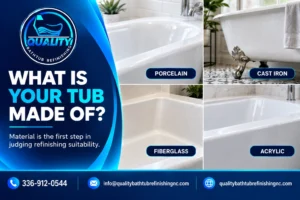
A caution before the list: what any one company refinishes depends on the systems it uses, so treat the following as general industry context, not a promise about a specific tub. Quality Bathtub Refinishing NC’s site indicates it works with common tub materials and surfaces, including porcelain, cast iron, clawfoot tubs, and fiberglass-related services. For anything material-specific about your tub, a free estimate is the way to confirm.
Porcelain (porcelain-enameled) tubs
Porcelain-surfaced tubs are among the most commonly refinished, and on a sound tub a worn or stained porcelain surface can often be a good candidate. Suitability still depends on the condition of the surface and what lies beneath, but material is rarely the obstacle here.
Cast iron tubs
Cast iron tubs (typically porcelain-enameled over iron) are frequently refinished and are often prized enough that owners specifically want to keep them. The material tends to be a strong candidate when the tub is sound; the usual condition questions, chips, rust, and wear, still apply and are covered below.
Fiberglass tubs
Fiberglass tubs can often be candidates for refinishing, and fiberglass also has its own repair considerations because the material can crack, flex, or develop soft spots. Where the fiberglass itself is damaged rather than just the surface, repair may be needed first; that is a distinct service, and fiberglass tub repair is the relevant page. Suitability depends on the condition of the material and the coating system used.
Acrylic tubs
Acrylic tubs can sometimes be refinished, but acrylic is more variable, and suitability depends on the specific surface, its condition, and whether the coating system is appropriate for it. This is a material where professional evaluation is especially worthwhile rather than assuming a yes or a no.
Steel/enamel tubs
Enameled-steel tubs (a porcelain-type enamel over a steel body) are broadly similar to other enameled surfaces for refinishing purposes, with the same emphasis on the condition of the enamel and whether there is rust or chipping through to the steel. Material is often workable; condition governs.
Cultured marble
Cultured marble surfaces can sometimes be refinished depending on their condition and the system used. As with acrylic, it is variable enough that a professional look is the responsible way to confirm rather than assuming.
The through-line: for most common tub materials, refinishing is potentially possible, but “potentially” is doing real work in that sentence. No material is automatically suitable in every case, and none discussed here is automatically ruled out. Condition and the right coating system decide the individual case.
How the condition of the tub affects suitability
Even the most refinishable material is only a candidate if the tub is in suitable condition, because refinishing works on the surface, not the structure. It helps to think in three condition tiers.
Surface and cosmetic condition
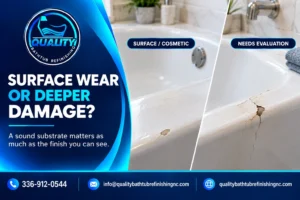
This is where refinishing is strongest: dullness, staining, discoloration, light scratches, minor chips, worn patches, and dated color. A sound tub with problems in this tier is usually a reasonable candidate.
Repairable localized damage
This sits in the middle: a chip that has exposed a small area, a minor crack, a spot of surface rust. Some of this can be addressed as part of the refinishing work, depending on size, location, material, and severity. It moves a tub from “straightforward” to “depends,” and it is a common reason to get an evaluation.
Structural and substrate damage
This is where refinishing alone may not be the answer: significant cracks, holes, extensive corrosion, a flexing or soft body, or a substrate that is failing. Refinishing does not rebuild a compromised tub, and these situations may call for repair first, or point toward replacement. They are exactly the conditions a professional should assess rather than a homeowner guessing.
The single most important idea in this whole guide: suitability is a question about the substrate, the body under the finish, as much as the finish itself. A beautiful-looking coating over a failing tub is not a success, which is why condition, not just appearance, drives the answer.
Can a damaged bathtub be refinished?
Sometimes, and the phrase that matters is “it depends on the damage.” Rather than a rule per defect, the same factors decide every case: the size of the damage, its location, the tub’s material, the severity, the condition underneath, whether it is repairable, and the state of any existing coating.
- Stains, discoloration, scratches, surface wear: usually surface-level, and often within what refinishing addresses on a sound tub.
- Chips: frequently addressable depending on size and location; a spreading chip or one exposing the substrate should be evaluated.
- Minor cracks: may be repairable depending on material and location; not a guaranteed disqualifier, but a reason for a professional look.
- Larger cracks and holes: more serious; these may require repair before refinishing is considered, or may indicate the tub’s integrity is affected.
- Rust and corrosion: surface rust is different from corrosion of the underlying material; refinishing does not repair structural corrosion, so the depth needs evaluation.
- A damaged substrate: the body itself being compromised is the condition most likely to move a tub out of “refinishing candidate” territory.
This guide does not provide repair instructions; its job is to help you judge whether damage is likely cosmetic, likely repairable, or likely beyond refinishing, and to recognize when that judgment needs a professional.
What about a previously refinished bathtub?
A tub that has already been refinished is not automatically disqualified from being refinished again. What matters is the condition of the existing coating and how well it is adhering.
If the previous coating is sound, recoating may be possible. If it is peeling, bubbling, flaking, or failing across areas, or if the previous coating is of unknown type or was applied over poor preparation, that changes things. The failing coating needs to be evaluated, because applying a new finish directly over a failing one tends to reproduce the failure. Depending on what the evaluation finds, the old coating may need appropriate remediation before a new system can be applied.
So the honest answer for a previously refinished tub is: possibly, but the existing coating has to be assessed first. What you should not do is assume another coat over a peeling surface will solve it. Understanding why preparation is so central helps here; our bathtub refinishing process overview explains that.
Is my bathtub too old to refinish?
Age by itself is not a suitability test. An old tub can be a strong candidate, and a newer tub can be unsuitable; the deciding factors are the same material-and-condition questions as everything above, not the year the tub was installed.
An older tub may be perfectly refinishable if the underlying fixture is sound and the problems are on the surface. In fact, older cast iron and porcelain tubs are often solidly built and specifically worth keeping. Conversely, a newer tub with serious underlying damage, a compromised substrate, or a failing prior coating may not be a good candidate despite its age. Let material and condition answer the question; the calendar does not.
How to identify your bathtub material
Knowing roughly what your tub is made of helps you understand its likely candidacy, though none of these clues is definitive and none of them requires you to test the tub destructively. Do not drill, scrape, chip, or damage the tub to find out; if the material is uncertain, that uncertainty is itself a reason for a professional look.
Cautious clues homeowners can use
Weight and era. Very heavy, older tubs are often cast iron. Cast iron and porcelain-enameled tubs are common in older homes.
Feel and sound. Fiberglass and acrylic tubs are lighter and can feel slightly warmer to the touch than enameled metal; they may sound and feel less solid, and can flex slightly underfoot, where a cast iron tub feels rigid and cold. Tapping is sometimes suggested as a clue, but treat it as a hint, not a test.
Surface characteristics. Enameled surfaces (porcelain, cast iron, steel) tend to look glassy and hard; fiberglass and acrylic can look and feel more like a molded plastic, especially at worn spots.
Visible edges or worn areas. Where a chip or worn spot exposes the material beneath, the color and texture of that exposed layer can hint at the material (for example, dark iron under a chipped enamel surface).
Style. Freestanding clawfoot tubs are frequently cast iron or, in some cases, other materials; built-in alcove tubs vary widely.
If these leave you unsure, that is normal and fine. Material identification is one of the things a professional confirms during a free estimate, and getting it right matters because the coating system is matched to the material.
Signs you need a professional evaluation
Across materials and conditions, certain findings mean you should stop guessing and get a professional look, because the deciding facts are below the surface where they are hard to judge. Have the tub evaluated when you see significant cracks or holes, extensive rust or possible corrosion of the underlying material, a chip or worn area that exposes the substrate, a soft or flexing area, a previous coating that is peeling or has failed more than once, or when you simply cannot tell what the tub is made of. Quality Bathtub Refinishing NC offers free estimates, which is the low-commitment way to answer the questions this guide cannot answer for your specific tub. You can also see the scope of work on the bathtub refinishing services page.
Good candidate vs. needs further evaluation
Use these as considerations, not a scoring system. There is no total to tally; the point is to see which description your tub is closer to.
A bathtub tends to be a stronger candidate when:
- the underlying tub is structurally sound
- the main problem is surface appearance or wear
- the material is one commonly refinished and compatible with the intended system
- any damage is localized and likely repairable or within the system’s capabilities
- an existing previous coating is sound or suitable for remediation
- you want to keep the existing fixture
A bathtub warrants further evaluation when:
- there are significant cracks or holes
- there is extensive rust or possible corrosion
- the substrate appears damaged, soft, or flexing
- a previous coating is failing, or has failed repeatedly
- you are unsure what the tub is made of
- the problems may go beyond the surface
Most tubs that fall in the first group and are made of a commonly refinished material are reasonable candidates, subject to a professional confirming it. Tubs in the second group are not necessarily unsuitable, but they need a trained assessment before anyone can say. If your tub looks like a candidate and you want to weigh the money side, our guide on whether refinishing is worth it and the cost guide cover the next step.
Frequently asked questions
Can any bathtub be refinished?
Many can, but not all. Suitability depends on the material and the condition of the tub. Most common materials can potentially be refinished, but a tub with serious structural damage, a failing substrate, or a failing previous coating may need repair first or may not be a candidate. A professional evaluation confirms it for a specific tub.
Can a porcelain bathtub be refinished?
Porcelain-surfaced tubs are among the most commonly refinished, and a sound porcelain tub with a worn or stained surface is often a good candidate. Suitability still depends on the condition of the surface and the body beneath it.
Can a cast iron bathtub be refinished?
Cast iron tubs are frequently refinished and are often worth keeping. The material tends to be a strong candidate when the tub is sound; chips, rust, and wear are condition questions handled during evaluation.
Can a fiberglass bathtub be refinished?
Fiberglass tubs can often be candidates, but fiberglass can also crack, flex, or develop soft spots, in which case repair may be needed before refinishing. Suitability depends on the condition of the material and the coating system used.
Can an acrylic bathtub be refinished?
Sometimes. Acrylic is more variable, and suitability depends on the specific surface, its condition, and whether the coating system is appropriate. This is a material where a professional evaluation is especially worthwhile.
Can a cracked bathtub be refinished?
It depends on the crack. A minor crack may be repairable depending on the material and location; larger cracks can indicate the tub’s integrity is affected and may require repair before refinishing or point toward replacement. This is a case for professional assessment.
Can a chipped bathtub be refinished?
Localized chips can frequently be addressed as part of the refinishing process, depending on size and location. A chip that has spread or exposed the substrate should be evaluated rather than assumed to be a simple recoat.
Can a rusty bathtub be refinished?
It depends on how deep the rust goes. Surface rust is different from corrosion of the underlying material. Refinishing does not repair structural corrosion, so rust that reflects damage beneath the surface may need evaluation or repair first.
Can a previously refinished bathtub be refinished again?
Possibly, but not by simply adding another coat. The existing coating must be evaluated; if it is peeling or failing, it may need remediation before a new system can be applied. Recoating over a failing finish tends to repeat the problem.
Is my bathtub too old to refinish?
Not necessarily. Age alone does not determine suitability. A sound older tub can be a strong candidate, while a newer tub with serious underlying damage may not be. Material and condition decide it.
How do I know what material my bathtub is made of?
Clues like weight, feel, surface look, flex, and the material visible at worn spots can hint at it, but none is definitive, and you should never test the tub destructively. If you are unsure, a professional can identify the material during a free estimate, which matters because the coating system is matched to the material.