

Do you need repair, refinishing, or both?
It is easy to assume “repair” and “refinishing” are two names for the same thing, or two options you have to choose between. Neither is quite right. They are different kinds of work that solve different problems, and for many tubs the answer is not one or the other but both, in sequence: repair the damaged area first, then refinish the surface. For other tubs, the problem is purely on the surface and refinishing alone addresses it. And for some, the underlying condition means neither is the right path on its own.
This guide is about telling those situations apart. It explains what repair does, what refinishing does, and how to think about which your tub is likely to need, without diagnosing a tub no one can see. The short version: repair generally fixes a specific damaged area, refinishing generally restores or recoats the whole surface, and the correct approach depends on your tub’s material, the nature of the damage, and the condition underneath.
If you want to go deeper on the damage itself, our guide to bathtub surface damage classifies the types in detail, and whether your tub can be refinished covers material-and-condition eligibility. This page is specifically about the repair-versus-refinishing decision.
Repair vs. refinishing: what’s the difference?
Bathtub repair generally addresses a specific defect or damaged area. It is targeted work on a problem spot: a chip filled, a crack addressed, a hole restored, a fiberglass area rebuilt, corrosion-affected material dealt with. Repair is about restoring the integrity or continuity of a damaged area so it is sound again. What “repair” involves varies a great deal by material and by the type of damage; a chip in an enameled surface and a crack in a fiberglass tub are not the same job.
Bathtub refinishing generally addresses the surface as a whole. It restores or changes the visible finish by preparing the existing surface and applying a new coating system to it. Refinishing is about the finish across the tub, not one damaged spot. (Refinishing goes by several names, reglazing, resurfacing, recoating; if the terminology is confusing, our terminology guide sorts it out, and the refinishing process guide covers how it is done.)
The relationship between them is the important part: they are not necessarily competing solutions. A tub can need repair, refinishing, both, or, in some cases, neither because the condition calls for something else. The rest of this guide is about which of those your situation is likely to be.
When a bathtub may need repair
Repair tends to be part of the picture when there is a specific, localized defect that has to be made sound, especially when it affects more than just the finish. Situations that may call for repair include a hole in the tub, a significant crack, a deeper chip that has exposed the material beneath, damage to the substrate, corrosion that has affected the underlying material, and areas where the tub’s material itself needs to be restored before anything else is done. Remediation of a failing previous coating is also a form of repair-type work in the sense that the damaged surface has to be dealt with, not just covered.
The common thread is that repair addresses something a coating cannot fix on its own. A new finish laid over an unrepaired hole, a live crack, or a corroded spot does not restore the damaged area; it just coats it. So where the damage compromises the area’s integrity or leaves an unsuitable surface, repair is what makes the tub sound again. Whether a specific defect actually needs repair, and whether it can be repaired, depends on its material, severity, and location, which is an evaluation question rather than something to decide from a description.
When refinishing may address the main problem
In many cases the problem is not a discrete defect at all but the overall condition of the surface, and that is refinishing’s territory. When the main issue is a dull or worn finish, discoloration, cosmetic staining that will not clean off, minor surface scratches, an outdated appearance, or a generally tired-looking surface on a tub that is otherwise sound, refinishing addresses the surface as a whole without necessarily needing a separate repair first.
The qualifier the brief-writer in all of us should keep in mind: refinishing is not automatically sufficient just because the problem looks cosmetic. The surface and the tub beneath still have to be in suitable condition for the coating system to bond and perform. A surface that looks merely worn but is actually pitted, failing, or hiding a deeper problem may still need evaluation. So “refinishing may be enough” is the likely answer for genuine surface wear on a sound tub, not a guarantee for anything that happens to look cosmetic.
When both repair and refinishing may be needed
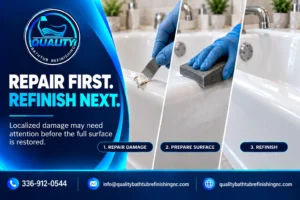
This is the situation homeowners most often miss, and it is where the two services work together rather than compete. When a tub has a localized defect and a generally worn surface, the appropriate approach is frequently a sequence rather than a choice. Conceptually, it looks like this:
- Evaluate the tub to understand the material, the damage, and the condition of the surface and substrate.
- Repair the localized damage where necessary and appropriate, so the affected area is sound.
- Prepare the surface so it is suitable for a new coating.
- Refinish or recoat the surface where appropriate, restoring the finish across the whole tub.
That is the concept, not a detailed procedure; the full step-by-step is in the refinishing process guide. The point here is simply that repair and refinishing are often complementary. Repair makes the damaged area sound; refinishing restores the surface over the sound tub. Thinking of them as an either/or is what leads homeowners to either coat over a problem that needed repair, or assume a repairable tub needs replacing.
Common damage examples and what they may call for
Brief notes on the damage types homeowners ask about, framed around the repair-versus-refinish decision rather than a full damage taxonomy (that is Guide #13). In every case, the specifics decide the answer, and that is an evaluation question.
Cracks. Differentiate cracks in a surface coating and superficial crazing from cracks involving the underlying material and significant structural cracks. Surface-level cracking may be within what surface work addresses; cracks that involve the tub’s material may require repair assessment before refinishing, or may point elsewhere. Cracks are not something to diagnose from a distance.
Chips. Chips vary by depth, size, location, and the material affected. A minor surface chip and a deeper chip that exposes the substrate should not be treated the same way; the deeper one is more likely to need a localized repair before refinishing. There is no universal rule that every chip does, or does not, need repair first.
Holes. A hole is generally a more substantial defect than ordinary surface wear, because the material is penetrated. If repair is appropriate, it typically needs to restore the damaged area before any refinishing; refinishing does not itself structurally fill a hole. For fiberglass tubs, where the material has been holed or damaged, fiberglass tub repair is the relevant service.
Peeling or a failing previous coating. A peeling or failing coating should not simply be covered with another finish without appropriate assessment and preparation. The causes vary, preparation, application, substrate condition, coating compatibility, moisture or environmental conditions, and use or maintenance can all contribute, and no single one is universally to blame. Dealing with a failing coating is a repair-and-preparation question before it is a refinishing question.
Rust and corrosion. Distinguish surface rust from localized corrosion, corrosion tied to a damaged area, and extensive substrate deterioration. Refinishing does not repair structural corrosion of the underlying material. Surface rust may be handled during proper surface work, but corrosion affecting the material needs the underlying condition evaluated, and possibly repaired, first.
General surface wear. A dull, worn, or dated finish on a sound tub is the classic refinishing-alone case, no separate repair needed, provided the surface is suitable for the coating.

Why bathtub material matters
The right repair-versus-refinish approach depends partly on what the tub is made of, because both the damage and the repair behave differently by material. A crack or a soft spot in a fiberglass tub is a different situation, and a different repair, than a chip in a cast iron or porcelain-enameled tub; rust and chipping-through-to-metal are relevant to enameled metal tubs in ways they are not for plastics; and acrylic and cultured marble behave differently again. This is why there is no single “repair first or not” rule that applies across all tubs. For the fuller material-by-material picture, see whether your tub can be refinished; here the point is only that material is one of the factors that decides whether repair, refinishing, or both is appropriate.
What about a previously refinished tub?
A tub that already has a refinishing layer adds the coating itself as a factor. Damage may be in the existing coating rather than the original surface, and the coating’s adhesion and condition matter. If the previous coating is peeling, bubbling, flaking, of unknown or incompatible type, or was poorly prepared, that needs to be assessed, and dealing with it is repair-and-preparation work, not simply adding another coat. Recoating over a failing coating tends to reproduce the failure, so a previously refinished tub with a failing finish is a case where “repair or prepare first” applies before any refinishing.
When professional evaluation is appropriate
The recurring theme across repair and refinishing is that the deciding facts, whether damage reaches the tub’s material, whether a coating has truly failed, whether a crack is structural, are hard to judge without a trained look. It is worth having the tub professionally evaluated rather than guessing when there are cracks that may involve the material, any hole, deep or extensive rust, a chip that exposes the substrate, a soft or flexing area, or a previous coating that is failing. Quality Bathtub Refinishing NC offers free estimates, which is the practical way to learn whether your tub needs repair, refinishing, or both, and for fiberglass tubs where the material is damaged, fiberglass tub repair is a related service. You can see the scope of work on the bathtub refinishing services page. In cases where damage is beyond reasonable repair or refinishing, replacement becomes the third possibility; the refinishing versus replacement guide covers that decision in full.
Repair vs. refinishing quick reference
This is a general guide to how each situation may be approached, not a diagnostic tool. The right answer for a specific tub depends on material, severity, location, and a professional assessment.
| Problem | Possible treatment | Why | Needs professional evaluation? |
| Surface dullness | Refinishing may be appropriate | A worn finish on a sound tub is a surface issue | Usually no, unless the surface may be failing |
| Staining / discoloration | Cleaning or refinishing may be appropriate | May be a maintenance issue, or finish-level staining | Sometimes, if tied to a rough or failing area |
| Minor scratches | Refinishing may be appropriate | Light surface scratching is typically cosmetic | Usually no, unless deep or exposing material |
| Small chips | Refinishing, sometimes with localized repair first | Depends on depth and location | Often, to confirm depth |
| Deeper chips exposing the substrate | Repair may be needed before refinishing | The exposed area must be made sound | Yes |
| Cracks | Often requires evaluation; repair may precede refinishing | Depends on whether it involves the tub’s material | Yes |
| Holes | Repair typically needed before any refinishing | The material is penetrated | Yes |
| Peeling / failing coating | Assessment and preparation, not simply recoating | The failing coating must be addressed | Yes |
| Rust / corrosion | Depends on depth; surface vs substrate | Refinishing does not repair structural corrosion | Yes, if it may involve the material |
| Structural / substrate damage | Repair, replacement assessment, or professional evaluation | Beyond what surface refinishing addresses | Yes |
Frequently asked questions
What is the difference between bathtub repair and refinishing?
Repair generally addresses a specific damaged area, such as a chip, crack, hole, or corroded spot, to make it sound again. Refinishing generally restores the whole surface by preparing it and applying a new coating. They solve different problems and are often used together rather than instead of each other.
Should you repair a bathtub before refinishing?
Sometimes. When there is localized damage that affects more than the finish, such as a deeper chip, a hole, or a crack involving the material, repair may need to come first so the area is sound before the surface is recoated. Purely cosmetic surface wear on a sound tub may not need a separate repair. The correct sequence depends on the material, damage, and condition.
Can a cracked bathtub be repaired and refinished?
It depends on the crack. Superficial crazing may be handled with surface work, while a crack involving the tub’s material may require repair assessment before refinishing. Cracks should be professionally evaluated rather than diagnosed from a distance.
Can a chipped bathtub be refinished?
Often, yes. Minor chips can frequently be addressed as part of refinishing, sometimes with a localized repair first. A deeper chip that exposes the substrate is more likely to need repair before refinishing. Size, location, and material decide it.
Can a hole in a bathtub be repaired before refinishing?
Where repair is appropriate, it typically needs to restore the damaged area before any refinishing, because refinishing does not itself structurally fill a hole. Whether a hole can be repaired depends on its size, location, and the tub’s material and condition.
Can a peeling bathtub be refinished?
Not by simply coating over the peeling. A failing coating needs to be assessed and appropriately prepared or remediated first, because a new finish over a failing one tends to fail too. After proper preparation, refinishing may be possible.
Does rust need to be repaired before refinishing?
It depends on how deep it goes. Surface rust may be handled during proper surface work, but rust that reflects corrosion of the underlying material needs the condition evaluated and possibly repaired first. Refinishing does not repair structural corrosion.
Can fiberglass tubs be repaired and refinished?
Fiberglass can be both repaired and refinished depending on the damage and condition. Fiberglass repair addresses cracks, holes, or soft or damaged areas in the material, and refinishing restores the surface; the two are often used together. Fiberglass repair is a distinct service.
Is refinishing enough for a damaged bathtub?
It depends on the damage. For surface-level wear on a sound tub, refinishing may be enough. For localized damage that affects the material or a failing coating, repair or preparation may be needed first. The honest answer requires knowing what kind of damage the tub has.